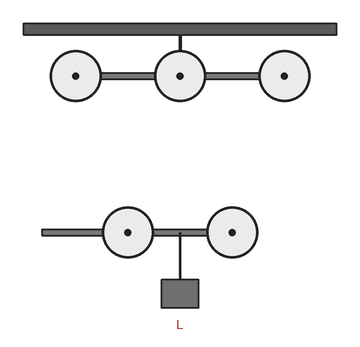
Solution:
Concept: In a block and tackle, every strand running between the two blocks pulls the lower block up with the tension T. If n strands hold up the lower block, then ideally L = nT and E = T, so M.A. = n; and when the load rises by x, each of the n strands shortens by x, so the effort end moves nx and V.R. = n. With the effort applied downward, this number equals the number of pulleys.
(a)
Step 1 — Draw the tackle and mark L and E.
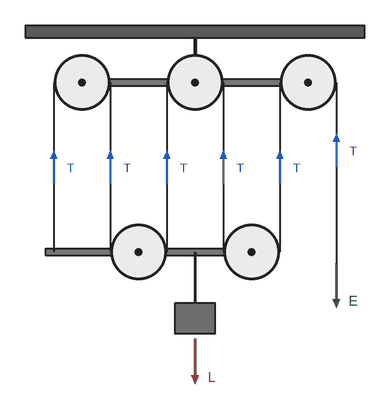
Tie the string to the hook of the lower block, pass it alternately over the 3 upper pulleys and under the 2 lower pulleys, and let the free end come down from the last upper pulley. The load L acts downward on the lower block, and the effort E acts downward at the free end.
(b)
Step 2 — Find the distance moved by the effort.
5 strands support the load, so V.R. = 5; when the load rises 1 m, each of the 5 strands shortens by 1 m.
dE=V.R.×dL=5×1 m=5 m
(c)
Step 3 — Count the supporting strands.
The strands running between the two blocks are the ones that hold up the load; there are 5 of them.
(d)
Step 4 — Find the mechanical advantage.
Each strand carries a tension equal to the effort, so ideally L = 5E and the M.A. equals the number of supporting strands, 5 (no friction, weightless lower block).
Therefore, (b) the effort moves 5 m, (c) 5 strands support the load, and (d) the M.A. of the system is 5.