Solution:
Concept: Mechanical advantage M.A. = load ÷ effort; velocity ratio V.R. = distance moved by the effort ÷ distance moved by the load (in the same time); efficiency η = work output ÷ work input, which works out to M.A. ÷ V.R. In a block and tackle, every strand running between the two blocks pulls the lower block up with the tension T. If n strands hold up the lower block, then ideally L = nT and E = T, so M.A. = n; and when the load rises by x, each of the n strands shortens by x, so the effort end moves nx and V.R. = n.
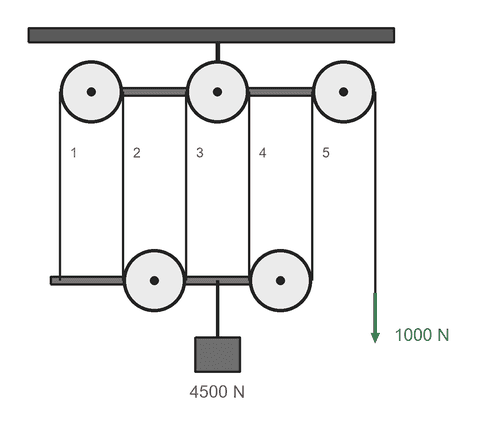
Given: Block and tackle of 5 pulleys; effort E = 1000 N (downward); load L = 4500 N.
(a)
Step 1 — Find the mechanical advantage.
Divide the load by the effort.
M.A.=1000 N4500 N=4.5
(b)
Step 2 — Find the velocity ratio.
With 5 pulleys and the effort applied downward, 5 strands hold up the lower block, so the V.R. is 5.
(c)
Step 3 — Find the efficiency.
Divide the M.A. by the V.R.
η=54.5=0.9
That is 90%. An ideal system would need only 4500 ÷ 5, that is 900 N; the extra 100 N goes into friction and into lifting the lower block.
Therefore, (a) the M.A. is 4.5, (b) the V.R. is 5, and (c) the efficiency is 90%.
