
Question 533 marksEasy
A crowbar of length 120 cm has its fulcrum situated at a distance of 20 cm from the load.

Calculate the mechanical advantage of the crowbar.
Confirming your payment
Sign up now and get 250 free tokens.
Machines · Question 53 of 109
A crowbar of length 120 cm has its fulcrum situated at a distance of 20 cm from the load.
Calculate the mechanical advantage of the crowbar.
Solution:
Concept: A crowbar is a class I lever: the load is at one end, the effort at the other end and the fulcrum in between. A lever balances when the moments about its fulcrum are equal (principle of moments): load × load arm = effort × effort arm. Since M.A. is load ÷ effort, for a lever M.A. = effort arm ÷ load arm, where the load arm and the effort arm are the distances of the load and of the effort from the fulcrum.
Given: Length of crowbar = 120 cm; distance of the fulcrum from the load = 20 cm.
Step 1 — Find the load arm.
The load arm is the distance of the load from the fulcrum, which is given.
Step 2 — Find the effort arm.
The effort acts at the other end of the 120 cm bar, so its distance from the fulcrum is the rest of the bar.
Step 3 — Find the mechanical advantage.
Divide the effort arm by the load arm.
So the crowbar can lift a load 5 times the effort applied.
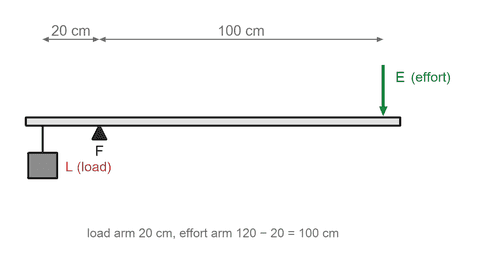
Watch out: The effort arm is 120 − 20 = 100 cm, not the whole 120 cm length of the bar.
Therefore, the mechanical advantage of the crowbar is 5.