
Question 525 marksEasy
Draw diagrams to illustrate the positions of fulcrum, load and effort, in each of the following :
(a) A seesaw
(b) A common balance
(c) A nut cracker
(d) Forceps.
Confirming your payment
Sign up now and get 250 free tokens.
Machines · Question 52 of 109
Draw diagrams to illustrate the positions of fulcrum, load and effort, in each of the following :
(a) A seesaw
(b) A common balance
(c) A nut cracker
(d) Forceps.
Solution:
Concept: For each device, find the point about which it turns (F), where the resistance acts (L) and where we push (E). Levers are classed by which of the fulcrum (F), the load (L) and the effort (E) lies in the middle: F in the middle → class I; L in the middle → class II; E in the middle → class III.
Step 1 — (a) A seesaw.
The fulcrum is the pivot at the middle; the child at one end is the load and the child at the other end applies the effort. F is in the middle: class I.
Step 2 — (b) A common balance.
The fulcrum is the central knife edge; the object in one pan is the load and the weights in the other pan are the effort. F is in the middle and the arms are equal, so M.A. = 1: class I.
Step 3 — (c) A nut cracker.
The fulcrum is the hinge at one end, the nut (load) is in between, and the effort is applied at the ends of the handles. L is in the middle: class II, with M.A. > 1.
Step 4 — (d) Forceps.
The fulcrum is the joined end, the effort is applied by the fingers in the middle, and the load (the object gripped) is at the tips. E is in the middle: class III, with M.A. < 1.
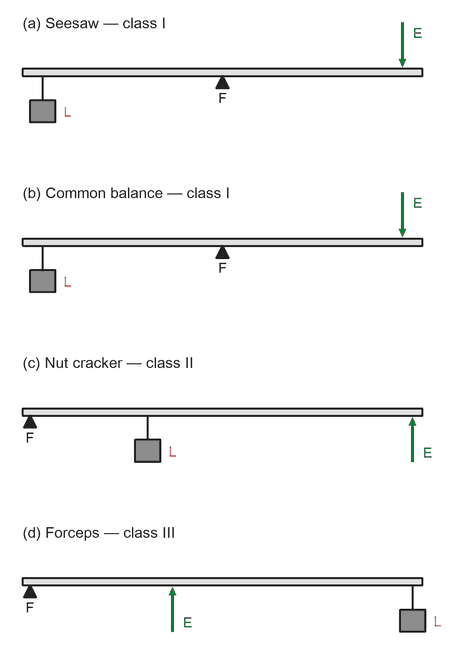
Therefore, the seesaw and the common balance are class I levers, the nut cracker is a class II lever and forceps are a class III lever, as the diagrams show.