Solution:
Concept: The weight of a uniform rule acts at its middle. Here the weight W is the load, so we apply the principle of moments about the fulcrum: load × load arm = effort × effort arm.
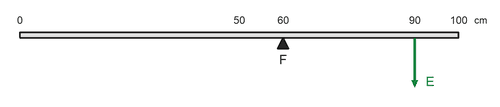
Given: Fulcrum at the 60 cm mark; effort E at the 90 cm mark; uniform rule of weight W.
Step 1 — Locate the weight.
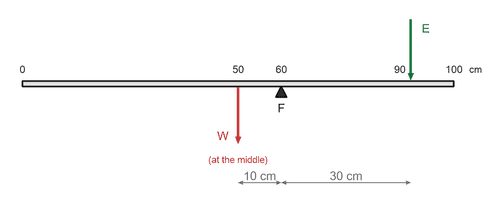
The rule is uniform, so its weight W acts at its middle, the 50 cm mark.
Step 2 — Find the two arms.
Each arm is the distance of the force from the fulcrum at the 60 cm mark.
Load arm=60−50=10 cm
Effort arm=90−60=30 cm
(a)
Step 3 — Compare W with E.
In equilibrium the moments about F balance.
W×10=E×30
Dividing both sides by 10 gives the result below.
W=3E
So W is greater than E. The weight acts nearer to the fulcrum than the effort, so it must be larger for the moments to balance.
(b)
Step 4 — Find the ideal M.A.
In the ideal case M.A. = effort arm ÷ load arm.
M.A.=Load armEffort arm=10 cm30 cm=3
Watch out: The load here is the rule's own weight, acting at the 50 cm mark, not at the 0 cm end.
Therefore, (a) W is greater than E (W = 3E), because W acts nearer the fulcrum, and (b) the mechanical advantage in the ideal case is 3.