
Question 444 marksEasy
Explain why scissors for cutting cloth may have blades longer than the handles, but shears for cutting metals have short blades and long handles.
Confirming your payment
Sign up now and get 250 free tokens.
Machines · Question 44 of 109
Explain why scissors for cutting cloth may have blades longer than the handles, but shears for cutting metals have short blades and long handles.
Solution:
Concept: Both are class I levers with the rivet as the fulcrum. The blades form the load arm and the handles form the effort arm, and M.A. = effort arm ÷ load arm.
Step 1 — See what cutting cloth needs.
Cloth offers very little resistance, so a large force is not needed. What is wanted is a long, fast cut.
Step 2 — Explain the design of cloth scissors.
With blades longer than the handles, the load arm is longer than the effort arm, so M.A. < 1 and V.R. < 1. A small movement of the fingers moves the blade tips through a large distance, so the scissors act as a speed multiplier.
Step 3 — See what cutting metal needs.
A metal sheet offers a large resistance, so a large force is needed at the blades.
Step 4 — Explain the design of metal shears.
With short blades and long handles, the effort arm is longer than the load arm, so M.A. > 1. A small effort at the handles produces a large cutting force, so the shears act as a force multiplier.
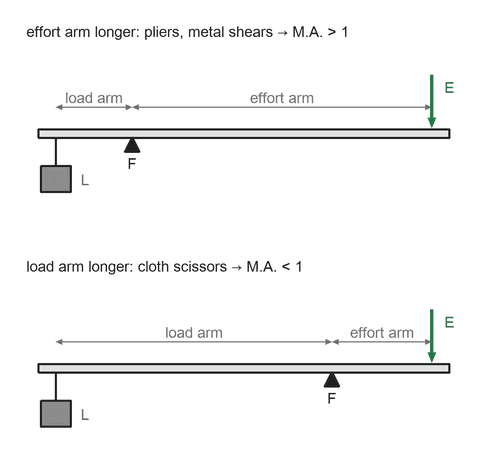
Therefore, cloth scissors have blades longer than the handles to gain speed (M.A. < 1), while metal shears have short blades and long handles to gain force (M.A. > 1).