
Question 663 marksMedium
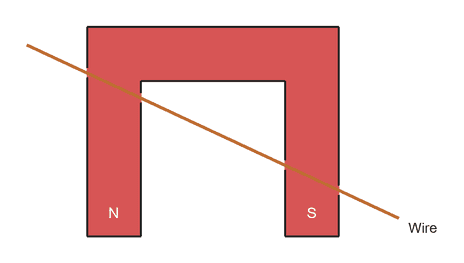
A copper wire is held between the poles of a magnet. There is a switch provided to reverse the current in the wire. Also, the polarity can be changed. In how many directions can the force act on the wire ?
Confirming your payment
Sign up now and get 250 free tokens.
Electro-magnetism · Question 66 of 136
A copper wire is held between the poles of a magnet. There is a switch provided to reverse the current in the wire. Also, the polarity can be changed. In how many directions can the force act on the wire ?
Solution:
Concept: By Fleming's left-hand rule, the force on a current-carrying wire is always at right angles to both the wire and the magnetic field. Reversing the current reverses the force; reversing the field (the polarity) also reverses it; reversing both leaves it unchanged.
Step 1 — Find the line along which the force acts.
The wire and the field (from N to S) both lie in the plane of the magnet, as in the figure. Only one line is at right angles to both of them: the line at right angles to that plane. So the force can only point one way or the opposite way along this line.
Step 2 — Try the four settings.
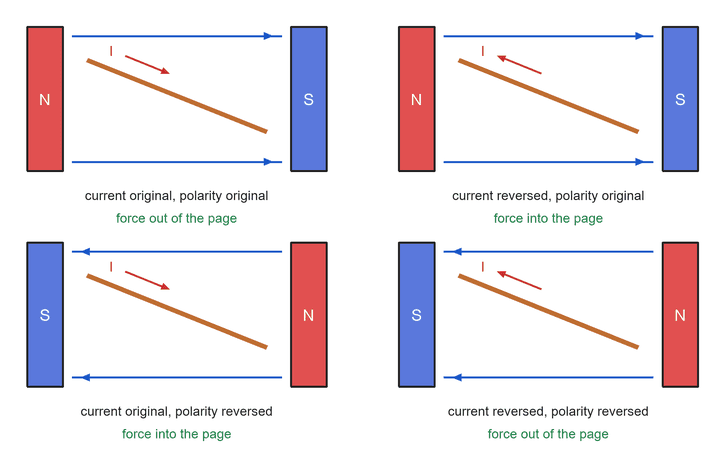
The switch and the change of polarity give four settings; the table shows the force for each.
| Current | Polarity | Force |
|---|---|---|
| original | original | out of the page |
| reversed | original | into the page |
| original | reversed | into the page |
| reversed | reversed | out of the page |
The figure shows the four settings with the force for each, out of or into the page.
Step 3 — Count the different directions.
The four settings give only two different directions, which are opposite to each other.
Watch out: Do not count the settings; count the different directions of the force they produce.
Note: The book's printed answer is "four directions". That counts the four settings of current and polarity, but they give only two different directions of the force, so the correct answer is two.
Therefore, the force can act in two directions only, opposite to each other, at right angles to the plane containing the wire and the field.