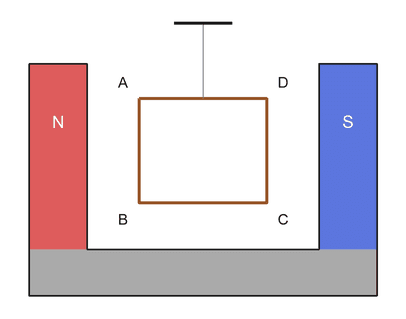
Solution:
Concept: The two arms of the coil that lie across the field carry currents in opposite directions, so they feel equal and opposite forces. These form a couple, whose turning effect is the force multiplied by the perpendicular distance between the two lines of action.
(a)
Step 1 — Find the forces on the arms.
The two arms of the coil at right angles to the field (say AB and CD) carry currents in opposite directions. By Fleming's left-hand rule they feel equal and opposite forces, both at right angles to the field.
Step 2 — See what the forces do.
The two forces act along different lines, so they form a couple and the coil rotates about its suspension.
(b)
Step 3 — Find where the coil stops.
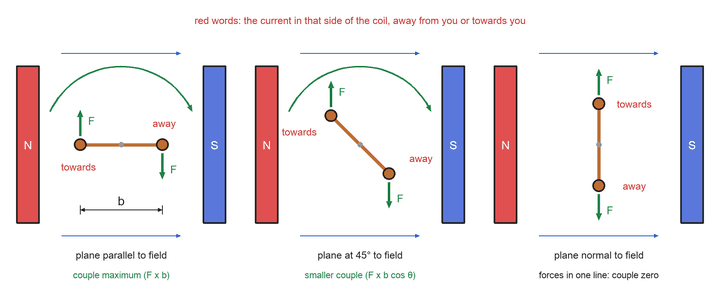
As the coil turns, the lines of the two forces come closer, and when the plane of the coil is normal (perpendicular) to the field the forces act along the same line, so the couple is zero. The coil comes to rest in this position, after swinging about it for a while.
(c)
Step 4 — Maximum couple.
The couple is maximum when the plane of the coil is parallel to the field, because the two forces are then farthest apart (the whole width of the coil).
Step 5 — Minimum couple.
The couple is minimum (zero) when the plane of the coil is normal to the field, because the two forces then act along one line and only stretch the coil.
The figure shows the coil seen end-on in three positions: plane parallel to the field (largest couple), at 45° (smaller couple) and normal to the field (forces in one line, no couple).
(d)
Step 6 — Name the instrument.
This principle is used in the d.c. motor (and also in the moving-coil galvanometer).
Watch out: The forces on the arms are just as large in every position; it is their turning effect (the couple) that changes, because the distance between their lines of action changes.
Therefore, (a) the coil rotates because of the couple, (b) it comes to rest when its plane is normal to the field, (c) the couple is (i) maximum when the plane of the coil is parallel to the field and (ii) minimum (zero) when it is normal to the field, and (d) the principle is used in the d.c. motor.