
Question 1163 marksEasy
Name two kinds of energy losses in a transformer. How are they minimised ?
Confirming your payment
Sign up now and get 250 free tokens.
Electro-magnetism · Question 116 of 136
Name two kinds of energy losses in a transformer. How are they minimised ?
Solution:
Concept: In a real transformer the output energy is a little less than the input energy. The difference is lost, mostly as heat, in the core and in the coils. The main energy losses in a transformer are eddy-current loss in the core (cut down by a laminated core of thin insulated soft iron sheets), hysteresis loss in the core (cut down by using soft iron, which is easily magnetised and demagnetised), copper (I²R) loss in the coils (cut down by thick copper wire) and flux leakage (cut down by winding the coils over each other on a closed core).
Step 1 — Name the first loss and its remedy.
The first is the eddy current loss. The changing flux induces circulating currents in the iron core, which heat it. It is minimised by using a laminated core of thin soft iron sheets insulated from each other.
Step 2 — Name the second loss and its remedy.
The second is the copper loss, the I²R heating of the coils by the currents in them. It is minimised by using thick copper wire (of low resistance), especially for the coil that carries the larger current.
Step 3 — Know the other losses.
The hysteresis loss (energy spent in magnetising the core again and again) is minimised by making the core of soft iron. The flux leakage (some flux of the primary not passing through the secondary) is minimised by using a closed core with the two coils wound over each other.
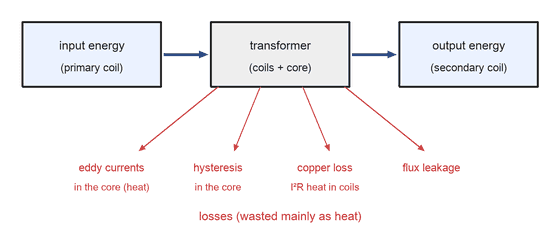
The figure shows the energy entering at the primary and leaving at the secondary, with the four losses branching off in between.
Therefore, two energy losses in a transformer are (1) the eddy current loss, minimised by a laminated soft iron core, and (2) the copper (I²R) loss, minimised by using thick copper wire for the coils.