
Question 1152 marksEasy
Why is the iron core of a transformer made laminated (thin sheets) instead of being in one solid piece ?
Confirming your payment
Sign up now and get 250 free tokens.
Electro-magnetism · Question 115 of 136
Why is the iron core of a transformer made laminated (thin sheets) instead of being in one solid piece ?
Solution:
Concept: The core of a transformer carries a changing magnetic flux. The iron of the core is itself a conductor, so this changing flux induces e.m.f.s in the iron and drives circulating currents in it, called eddy currents, which waste energy as heat.
Step 1 — See what happens in a solid core.
In a solid iron core the eddy currents can circulate round large paths of low resistance, so they are large. They heat the core and waste much energy.
Step 2 — See what lamination does.
A laminated core is made of thin sheets of soft iron, insulated from each other by a coat of varnish. Each eddy current is now confined to one thin sheet, where its path is narrow and its resistance high, so the eddy currents are very small and the energy lost as heat is greatly reduced.
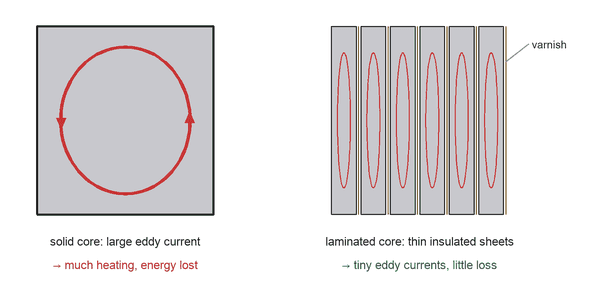
The figure compares the two: a large eddy current circulating in the solid core, and only tiny eddy currents in the separate, insulated sheets of the laminated core.
Watch out: Lamination does not stop the flux; it only cuts down the eddy currents, so the transformer still works.
Therefore, the iron core is laminated so that the eddy currents induced in it are kept very small, which greatly reduces the energy wasted as heat in the core.