
Question 1323 marksEasy
The magnetic flux through a coil having 100 turns decreases from 5 milli weber to zero in 5 second. Calculate the e.m.f. induced in the coil.
Confirming your payment
Sign up now and get 250 free tokens.
Electro-magnetism · Question 132 of 136
The magnetic flux through a coil having 100 turns decreases from 5 milli weber to zero in 5 second. Calculate the e.m.f. induced in the coil.
Solution:
Concept: Faraday's laws: (1) Whenever the magnetic flux linked with a coil changes, an e.m.f. is induced in it, and it lasts only while the change goes on; (2) the size of the induced e.m.f. is directly proportional to the rate of change of the flux linked with the coil. For N turns, e = N × (change of flux ÷ time taken) in size.
Given: N = 100 turns; the flux falls from 5 mWb to 0, so Δφ = 5 mWb; Δt = 5 s.
Step 1 — Change the flux into weber.
The flux falls from 5 milliweber to zero, and 1 mWb is 10⁻³ Wb, so the change of flux is
Step 2 — Find the rate of change of flux.
We divide the change of flux by the time taken, 5 s.
Step 3 — Find the induced e.m.f. in the coil.
By Faraday's law the e.m.f. is the number of turns times the rate of change of flux through each turn.
Step 4 — See what it means.
The flux falls steadily by 1 mWb every second, so each of the 100 turns has 1 mV induced in it, and the turns in series add up to 100 mV.
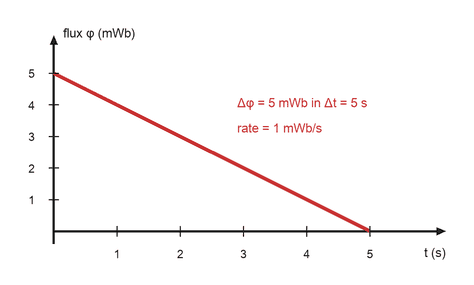
The graph shows the flux falling in a straight line from 5 mWb to zero in 5 s, a steady rate of 1 mWb per second.
Watch out: Change milliweber into weber (× 10⁻³) and multiply by the number of turns; 0.001 V is the e.m.f. of one turn only.
Therefore, the e.m.f. induced in the coil is 0.1 V (100 mV).