
Question 1313 marksEasy
How do the input and output powers in a transformer compare ? State the assumption made.
Confirming your payment
Sign up now and get 250 free tokens.
Electro-magnetism · Question 131 of 136
How do the input and output powers in a transformer compare ? State the assumption made.
Solution:
Concept: A transformer only passes energy from its primary to its secondary through the changing flux in the core; it cannot create energy.
Step 1 — Compare the powers.
For an ideal transformer, the output power is equal to the input power.
Step 2 — State the assumption.
This assumes that there is no loss of energy in the transformer: no eddy-current loss and no hysteresis loss in the core, no I²R heating of the coils, and no leakage of flux (all the flux of the primary passes through the secondary).
Step 3 — Say what happens in practice.
A real transformer has small losses of these kinds, so its output power is slightly less than its input power. Large transformers are very efficient, often more than 95 per cent.
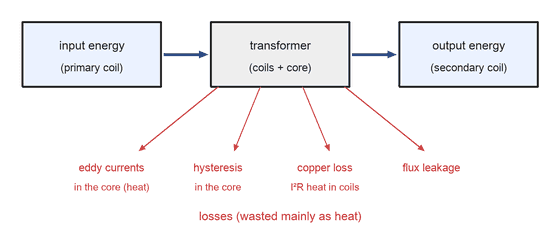
The figure shows the input energy, the output energy and the four losses (eddy currents, hysteresis, copper loss and flux leakage) in between.
Watch out: The output power is never MORE than the input power; only the voltage or the current can be increased, never both.
Therefore, the output power of a transformer equals its input power (Es × Is is equal to Ep × Ip), on the assumption that there is no loss of energy in the transformer.