
Question 861 markMCQEasy
Assertion (A) : A transformer cannot be used with a direct current.
Reason (R) : The lamination of core prevents the loss of energy due to induced currents in the core.
Confirming your payment
Sign up now and get 250 free tokens.
Electro-magnetism · Question 86 of 136
Assertion (A) : A transformer cannot be used with a direct current.
Reason (R) : The lamination of core prevents the loss of energy due to induced currents in the core.
(A) both A and R are true and R is the correct explanation of A
(B) both A and R are True and R is not the correct explanation of A
(C) assertion is false but reason is true
(D) assertion is true but reason is false
Answer: (B) both A and R are True and R is not the correct explanation of A
Concept: In an assertion–reason item, judge the assertion (A) and the reason (R) separately as true or false, and then decide whether R correctly explains A. A transformer works only with a.c., because only a changing flux in its core induces an e.m.f. in the secondary.
Step 1 — Judge the assertion.
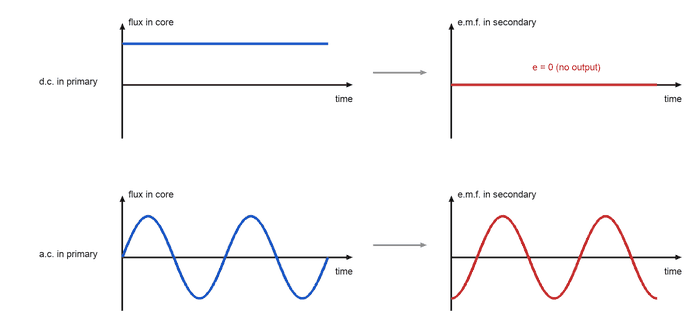
A steady d.c. in the primary sets up a constant flux in the core, and a constant flux induces no e.m.f. in the secondary. A is true.
The figure compares a steady d.c. in the primary, which gives a constant flux and zero e.m.f. in the secondary, with an a.c., which gives a changing flux and an alternating e.m.f. in the secondary.
Step 2 — Judge the reason.
A core made of thin sheets insulated from each other keeps the eddy currents (the currents induced in the core itself) small, so very little energy is lost as heat. Strictly the loss is reduced to a very small value rather than wholly prevented, which is what the book means. R is true.
Step 3 — Decide whether R explains A.
Lamination has nothing to do with why d.c. does not work: even a laminated core gives no output with d.c., because a steady flux induces no e.m.f. So R is not the correct explanation of A.
Watch out: Both statements are about transformers, but R is about cutting energy loss, not about why a.c. is needed.
Why the other options are wrong:
Therefore, both A and R are true, but R is not the correct explanation of A, option (B).