
Question 851 markMCQEasy
Assertion (A) : A transformer can increase the voltage of an alternating e.m.f.
Reason (R) : This is achieved by keeping the number of turns in the secondary coil less than the number of turns in the primary coil.
Confirming your payment
Sign up now and get 250 free tokens.
Electro-magnetism · Question 85 of 136
Assertion (A) : A transformer can increase the voltage of an alternating e.m.f.
Reason (R) : This is achieved by keeping the number of turns in the secondary coil less than the number of turns in the primary coil.
(A) both A and R are true and R is the correct explanation of A
(B) both A and R are True and R is not the correct explanation of A
(C) assertion is false but reason is true
(D) assertion is true but reason is false
Answer: (D) assertion is true but reason is false
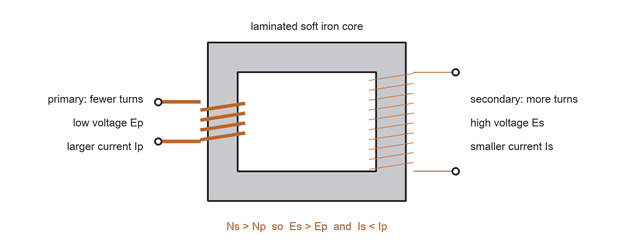
Concept: In an assertion–reason item, judge the assertion (A) and the reason (R) separately as true or false, and then decide whether R correctly explains A. In a transformer Es ÷ Ep is equal to Ns ÷ Np, so the voltage goes up only if the secondary has more turns than the primary.
Step 1 — Judge the assertion.
A step-up transformer increases an alternating e.m.f., so a transformer can increase the voltage of an alternating e.m.f. A is true.
Step 2 — Judge the reason.
R says this is done with fewer turns in the secondary than in the primary. Then Ns is less than Np, so Es is less than Ep and the voltage is decreased; that is a step-down transformer. R is false.
The figure shows a laminated soft iron core with a primary of few turns and a secondary of more turns, which gives a higher voltage and a smaller current in the secondary.
Step 3 — Decide the option.
With A true and R false, the answer is 'assertion is true but reason is false'.
Watch out: To step the voltage up, the secondary must have more turns than the primary, not fewer.
Why the other options are wrong:
Therefore, the assertion is true but the reason is false, option (D).