
Question 811 markMCQEasy
A step up transformer ............ the current whereas a step down transformer ................ the current.
Confirming your payment
Sign up now and get 250 free tokens.
Electro-magnetism · Question 81 of 136
A step up transformer ............ the current whereas a step down transformer ................ the current.
(A) increases, increases
(B) decreases, decreases
(C) decreases, increases
(D) increases, decreases
Answer: (C) decreases, increases
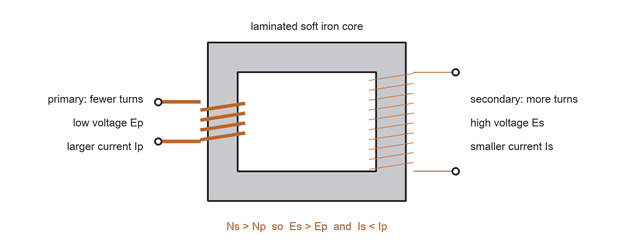
Concept: A transformer works on mutual induction and only with a.c.: the changing current in the primary coil sets up a changing flux in the soft iron core, and this changing flux, linked with the secondary coil, induces an e.m.f. in it. The e.m.f. per turn is the same in both coils, so Es ÷ Ep is equal to Ns ÷ Np (the turns ratio). In an ideal transformer the power in equals the power out, so the current changes the opposite way: Is ÷ Ip is equal to Np ÷ Ns.
Step 1 — Use the power balance.
In an ideal transformer no energy is lost, so the power given out by the secondary equals the power taken in by the primary.
Step 2 — Find how the current changes.
Dividing both sides by Es × Ip shows that the current changes in the opposite way to the voltage.
Step 3 — Apply it to a step-up transformer.
A step-up transformer raises the voltage (Es greater than Ep), so Is is less than Ip: it decreases the current.
Step 4 — Apply it to a step-down transformer.
A step-down transformer lowers the voltage (Es less than Ep), so Is is greater than Ip: it increases the current.
The figure shows a laminated soft iron core with a primary of few turns and a secondary of more turns, which gives a higher voltage and a smaller current in the secondary.
Watch out: A transformer gives no extra power; when it raises the voltage, it must lower the current.
Why the other options are wrong:
Therefore, a step-up transformer decreases the current, whereas a step-down transformer increases it, option (C).