
Question 801 markMCQEasy
In a step up transformer :
Confirming your payment
Sign up now and get 250 free tokens.
Electro-magnetism · Question 80 of 136
In a step up transformer :
(A)
(B)
(C)
(D) nothing can be said
Answer: (C)
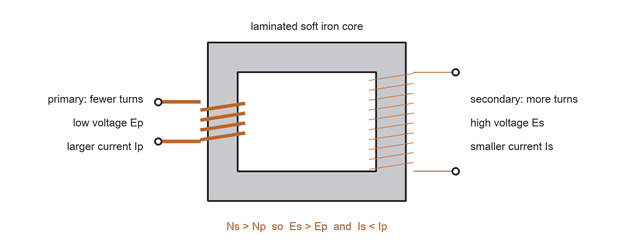
Concept: A transformer works on mutual induction and only with a.c.: the changing current in the primary coil sets up a changing flux in the soft iron core, and this changing flux, linked with the secondary coil, induces an e.m.f. in it. The e.m.f. per turn is the same in both coils, so Es ÷ Ep is equal to Ns ÷ Np (the turns ratio). In an ideal transformer the power in equals the power out, so the current changes the opposite way: Is ÷ Ip is equal to Np ÷ Ns.
Step 1 — Write the voltage ratio.
In a transformer the e.m.f. in each coil is proportional to its number of turns.
Step 2 — Use the meaning of step-up.
A step-up transformer gives an output voltage higher than its input, so Es is greater than Ep and the ratio Es ÷ Ep is more than 1.
Step 3 — Compare the turns.
Since the two ratios are equal, Ns ÷ Np is also more than 1, so the secondary coil has more turns than the primary.
The figure shows a laminated soft iron core with a primary of few turns and a secondary of more turns, which gives a higher voltage and a smaller current in the secondary.
Watch out: The word 'step-up' refers to the voltage, and it is the secondary (output) coil that has more turns.
Why the other options are wrong:
Therefore, in a step-up transformer the secondary has more turns than the primary, Ns > Np, option (C).