Solution:
Concept: Each arm of a U-shaped (horse-shoe) core acts like a short electromagnet. Looking at the free end of each arm and applying the clock rule tells its pole; for the U to be a useful magnet, the two free ends must be opposite poles. Clock rule: Look at one face (end) of a current loop or solenoid. If the current at that face flows anticlockwise, the face behaves as a north pole; if it flows clockwise, the face behaves as a south pole.
(a)
Step 1 — Read the current on arm A.
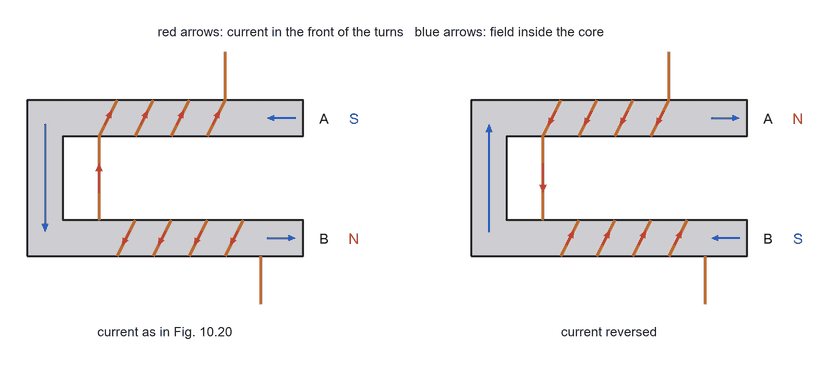
In Fig. 10.20 the current flows up the front of the turns on the arm ending at A. Seen from end A, it goes round clockwise, so A is a south pole.
Step 2 — Read the current on arm B.
On the arm ending at B the current flows down the front of the turns. Seen from end B, it goes round anticlockwise, so B is a north pole.
(b)
Step 3 — Reverse the current.
Reversing the current reverses its sense of rotation on both arms, so the poles change places: A becomes a north pole and B a south pole.
The figure shows the core with the current as in Fig. 10.20 (A south, B north) and with the current reversed (A north, B south).
(c)
Step 4 — Make the field stronger.
The field of an electromagnet grows with the current and the number of turns, so increase the current in the coil (or wind more turns on each arm).
Watch out: The poles depend on the sense of the current round each arm as seen from its free end, so both poles change together when the current is reversed.
Therefore, (a) A is a south pole and B a north pole, (b) on reversing the current A becomes a north pole and B a south pole, and (c) the field can be made stronger by increasing the current (or the number of turns).

