
Question 474 marksMedium
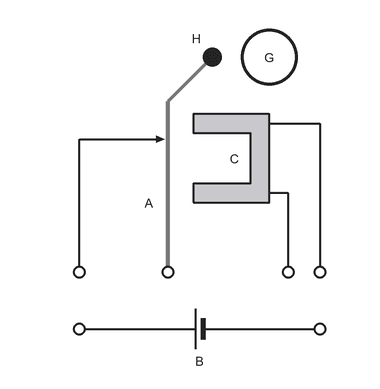
The incomplete diagram of an electric bell is given in Fig 10.21. Draw winding of coil on the core and complete the electric circuit in the diagram
G–Gong
H–Hammer
A–Armature
C–Core
B–Battery
Confirming your payment
Sign up now and get 250 free tokens.
Electro-magnetism · Question 47 of 136
The incomplete diagram of an electric bell is given in Fig 10.21. Draw winding of coil on the core and complete the electric circuit in the diagram
G–Gong
H–Hammer
A–Armature
C–Core
B–Battery
Solution:
Concept: In an electric bell the battery, the contact screw, the soft iron armature and the coil of the electromagnet are joined in series. The armature itself makes and breaks the circuit, so the electromagnet is switched on and off again and again and the hammer keeps striking the gong.
Step 1 — Wind the coil on the core.
Wind insulated copper wire on the soft iron core C, all in the same sense, and bring its two ends to the two terminals on the right of the figure.
Step 2 — Complete the series circuit.
Join the parts so that the current passes through each of them in turn. One terminal of battery B goes to the contact screw, which touches the armature A; the armature's terminal is joined to one lead of the coil; and the other lead of the coil returns to the other terminal of the battery.
The completed figure shows the coil on the core and these connections.

Step 3 — Follow how the bell works.
When the circuit is complete, current flows and the core C becomes an electromagnet. It attracts the soft iron armature A, so the hammer H strikes the gong G.
Step 4 — See how the circuit breaks and remakes itself.
As the armature moves towards the core, it leaves the contact screw, which breaks the circuit, and the core loses its magnetism. The spring brings the armature back to the contact screw, which completes the circuit again, and the cycle repeats.
Watch out: The contact screw and the armature must be in the same series path as the coil; if the coil were joined straight across the battery, the armature would be held against the core and the bell would not ring.
Therefore, the coil is wound on the core C and joined in series with the battery B, the contact screw and the armature A, so the armature makes and breaks the circuit and the bell rings continuously while the circuit is connected.