Solution:
Concept: Electromagnetic induction: An e.m.f. is induced in a coil whenever the magnetic flux linked with it changes. If the circuit is closed, this e.m.f. drives an induced current, which lasts only as long as the flux keeps changing. Increasing flux and decreasing flux give induced currents in opposite directions (Lenz's law), and a centre-zero galvanometer shows this by deflecting to opposite sides.
(a)
Step 1 — Observe while the magnet moves in rapidly.
As the magnet moves rapidly into the coil, the flux linked with the coil increases quickly, so a current is induced. The galvanometer shows a momentary deflection to one side, say to the right, lasting only while the magnet moves. This is part (i).
Step 2 — Find the direction of this current.
By Lenz's law the face of the coil nearer the magnet becomes a north pole, to repel the approaching north pole. Following the winding in the diagram, this needs the current to enter the coil at its right-hand end and leave at its left-hand end, so it passes through G from its left terminal to its right terminal. (Which way the needle then swings depends on how the meter is made, so we simply call it 'to the right'.)
Step 3 — Observe while the magnet rests inside.
When the magnet is kept stationary inside the coil, the flux does not change, so no e.m.f. is induced. The needle comes back to zero and stays there. This is part (ii).
Step 4 — Observe while the magnet is pulled out rapidly.
As the magnet is pulled out, the flux decreases, so the induced current flows the other way. The galvanometer again shows a momentary deflection, but in the opposite direction (to the left). This is part (iii).
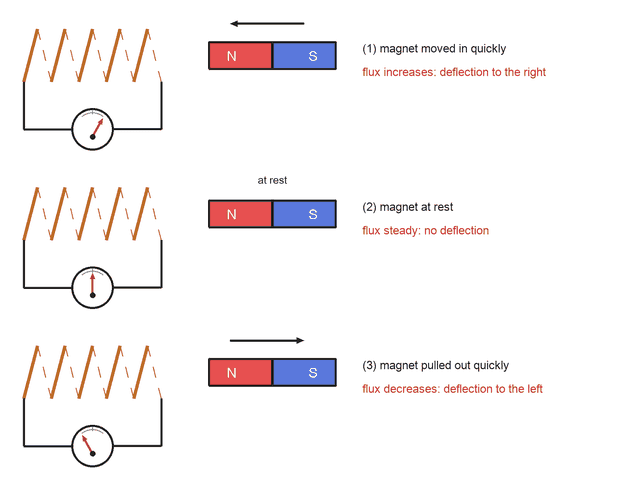
The figure shows the three observations: deflection to the right while the magnet moves in, no deflection while it is at rest, and deflection to the left while it is pulled out.
(b)
Step 5 — Use a more powerful magnet.
A stronger magnet moved in the same way changes the flux by a larger amount in the same time. The rate of change of flux is larger, so the induced e.m.f. and current are larger: the deflection is larger, and it is still to the right (the same side as in (i)).
Watch out: There is no deflection while the magnet rests inside the coil, even though the flux through the coil is largest then; only a changing flux induces a current.
Therefore, (a) (i) the galvanometer shows a momentary deflection (say to the right) while the magnet moves in rapidly, (ii) it shows no deflection while the magnet is stationary, and (iii) it shows a momentary deflection in the opposite direction (to the left) while the magnet is pulled out rapidly; (b) with a more powerful magnet the deflection in (i) is larger, on the same side.

