Solution:
Concept: Lenz's law: The induced current always flows in such a direction that it opposes the change in magnetic flux that produces it. This is the law of conservation of energy at work: the work done against this opposition is what appears as electrical energy. Clock rule: Look at one face (end) of a current loop or solenoid. If the current at that face flows anticlockwise, the face behaves as a north pole; if it flows clockwise, the face behaves as a south pole.
(i)
Step 1 — Decide which pole the near face must become.
The coil moves towards the north pole of the magnet, so the flux through it increases. To oppose this approach, the end of the coil facing the magnet (the right end, at B) must become a north pole, because like poles repel.
Step 2 — Use the clock rule.
A face is a north pole when the current, seen from in front of that face, flows anticlockwise. So, seen from the magnet's side, the current in the turns must flow anticlockwise.
Step 3 — Follow the winding.
In the diagram the wire from A goes up behind the core and comes down in front of it, turn after turn, ending at B. A current entering at A therefore flows up at the back and down at the front, which is anticlockwise when seen from the magnet's side. So the induced current flows from A to B through the coil.
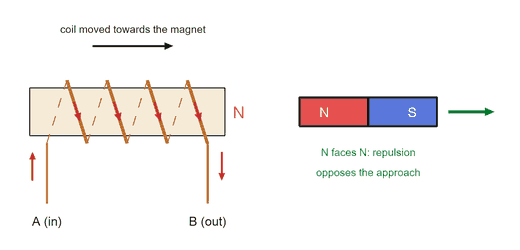
The figure marks the result: the current enters at A, flows down along the front of each turn and leaves at B, the right end of the coil becomes N, and the N pole of the magnet is repelled, which opposes the approach.
(ii)
Step 4 — Name the law.
The direction was found from Lenz's law: the induced current opposes the change that produces it.
(iii)
Step 5 — Double the number of turns.
Each turn has the same e.m.f. induced in it, so twice the number of turns gives twice the e.m.f. Taking the resistance of the circuit as unchanged, the induced current is doubled. This is part (a).
Step 6 — Move the coil three times as fast.
The flux now changes three times as fast, so by Faraday's law the induced e.m.f. becomes three times as large, and the induced current becomes three times as large. This is part (b).
Watch out: The near face of the coil becomes the SAME pole as the approaching pole (N facing N), not the opposite pole; an opposite pole would attract and help the motion.
Therefore, (i) the induced current flows from A to B through the coil, (ii) this follows from Lenz's law, and (iii) the current (a) is doubled with twice the number of turns and (b) becomes three times as large when the coil moves three times as fast.

