Solution:
Concept: Electromagnetic induction: An e.m.f. is induced in a coil whenever the magnetic flux linked with it changes. If the circuit is closed, this e.m.f. drives an induced current, which lasts only as long as the flux keeps changing. Lenz's law: The induced current always flows in such a direction that it opposes the change in magnetic flux that produces it. This is the law of conservation of energy at work: the work done against this opposition is what appears as electrical energy.
(a)
Step 1 — Describe one way.
Join a coil of many turns to a galvanometer and move a bar magnet quickly towards (or away from) the coil. The magnetic flux linked with the coil changes, so an e.m.f. is induced in it and the galvanometer deflects.
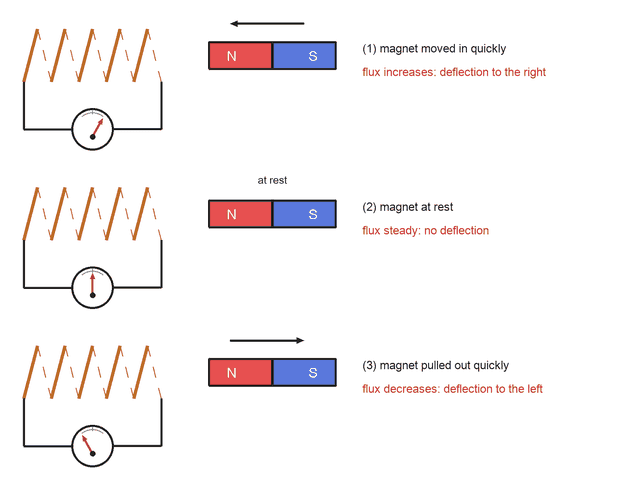
The figure shows the deflection while the magnet moves in, no deflection while it rests, and the opposite deflection while it is pulled out.
(b)
Step 2 — State a factor for the size.
The size of the induced e.m.f. depends on the speed of the magnet, that is, on the rate of change of the magnetic flux: a faster motion gives a larger e.m.f. (The number of turns in the coil and the strength of the magnet also affect it.)
(c)
Step 3 — State what fixes the direction.
The direction of the induced e.m.f. depends on the direction of motion of the magnet (towards or away from the coil) together with which pole faces the coil. Reversing either one reverses the e.m.f. The rule behind this is Lenz's law: the induced current always flows so as to oppose the change (the motion) that produces it.
Watch out: The size depends on how FAST the flux changes, not on how much flux is in the coil when the magnet is still.
Therefore, (a) an e.m.f. is induced by moving a bar magnet towards or away from a coil, (b) its size depends on the speed of the magnet (the rate of change of flux), and (c) its direction depends on the direction of motion of the magnet and on which pole faces the coil.
