
Question 1194 marksEasy
(a) What is electromagnetic induction ?
(b) Describe one experiment to demonstrate the phenomenon of electromagnetic induction.
Confirming your payment
Sign up now and get 250 free tokens.
Electro-magnetism · Question 119 of 136
(a) What is electromagnetic induction ?
(b) Describe one experiment to demonstrate the phenomenon of electromagnetic induction.
Solution:
Concept: Electromagnetic induction: An e.m.f. is induced in a coil whenever the magnetic flux linked with it changes. If the circuit is closed, this e.m.f. drives an induced current, which lasts only as long as the flux keeps changing.
(a)
Step 1 — Define electromagnetic induction.
Electromagnetic induction is the phenomenon in which an e.m.f. is induced in a conductor or coil whenever the magnetic flux linked with it changes. If the circuit is closed, this e.m.f. drives an induced current.
(b)
Step 2 — Set up the apparatus.
Join the two ends of a coil of many turns of insulated copper wire to a centre-zero galvanometer, which shows a current in either direction. Keep a strong bar magnet ready.
Step 3 — Push the magnet in.
Move the north pole of the magnet quickly towards (into) the coil. The galvanometer needle deflects to one side, say to the right, showing that a current flows.
Step 4 — Hold the magnet still.
Keep the magnet at rest inside or near the coil. The needle comes back to zero: no current flows while nothing moves.
Step 5 — Pull the magnet out.
Move the magnet quickly away from the coil. The needle deflects to the opposite side (to the left), so the current now flows the other way.
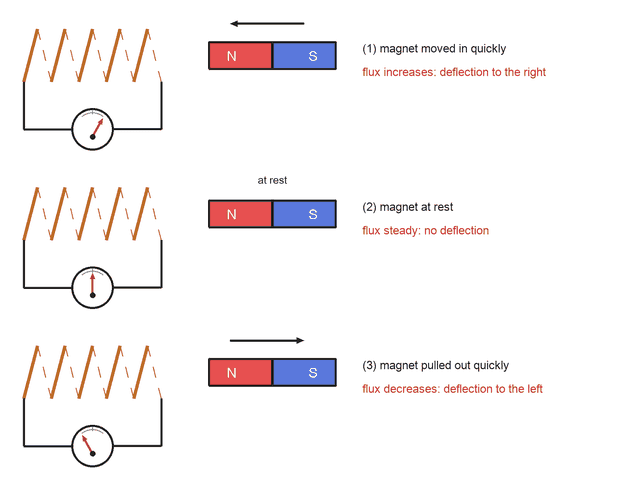
The figure shows these three stages: the magnet moved in quickly (deflection to the right), the magnet at rest (no deflection) and the magnet pulled out quickly (deflection to the left).
Step 6 — Change the speed, or move the coil instead.
Repeat with faster motion: the deflection is larger. Keeping the magnet still and moving the coil gives the same results, because only the relative motion matters.
Step 7 — Draw the conclusion.
A current is induced only while there is relative motion between the magnet and the coil, that is, only while the flux linked with the coil is changing. Its direction depends on the direction of motion, and its size on how fast the flux changes.
Watch out: A magnet resting inside the coil induces no current, however strong it is; the flux must be changing.
Therefore, (a) electromagnetic induction is the production of an e.m.f. (and a current in a closed circuit) in a coil whenever the magnetic flux linked with it changes, and (b) moving a bar magnet into and out of a coil joined to a centre-zero galvanometer shows it: the needle deflects only while the magnet moves, in opposite directions for in and out.