Solution:
Concept: A transformer needs a closed core of soft iron so that the flux produced by the primary passes through the secondary. A step-up transformer has more turns in the secondary than in the primary (Ns > Np), so it raises the voltage and lowers the current. A step-down transformer has fewer turns in the secondary (Ns < Np), so it lowers the voltage and raises the current.
(a)
Step 1 — Complete the diagram.
The two separate limbs are joined at the top and at the bottom by soft iron pieces, so that they form one closed core.
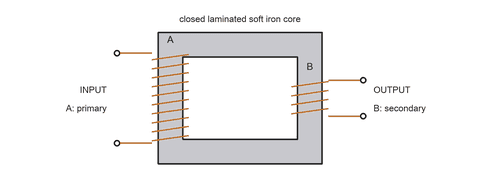
The completed figure shows the closed laminated soft iron core, with coil A (input) on the left limb and coil B (output) on the right limb.
Step 2 — Name the parts A and B.
The coil A is joined to the input, so it is the primary coil. The coil B is joined to the output, so it is the secondary coil.
(b)
Step 3 — Name the part drawn.
The part drawn to complete the diagram is the core (the closed core joining the two limbs). Without it, most of the field lines of A would spread out into the air and would not pass through B.
(c)
Step 4 — Name its material.
The core is made of soft iron, in thin laminated (insulated) sheets. Soft iron is easily magnetised and demagnetised, so it carries the changing flux well with little hysteresis loss, and lamination keeps the eddy-current loss small.
(d)
Step 5 — Decide step up or step down.
In the diagram the secondary coil B has fewer turns than the primary coil A (Ns < Np). The e.m.f.s are in the ratio of the turns, so the output voltage is less than the input voltage, and the transformer is step down.
Watch out: The core is made of SOFT iron, not steel; steel keeps its magnetism and would waste energy every cycle.
Therefore, (a) A is the primary coil and B is the secondary coil, (b) the part drawn is the closed core, (c) it is made of laminated soft iron, and (d) the transformer is step down, because the secondary B has fewer turns than the primary A.

