Solution:
Concept: In any triangle ABC the angles add up to 180°: A+B+C=180∘. So half of any two angles is 90° minus half of the third, for example 2A+B=90∘−2C.
Two angles are complementary when they add up to 90°. For complementary angles: sin(90∘−A)=cosA, cos(90∘−A)=sinA, tan(90∘−A)=cotA, cot(90∘−A)=tanA, sec(90∘−A)=cosecA and cosec(90∘−A)=secA.
Step 1 — Write the angle sum.
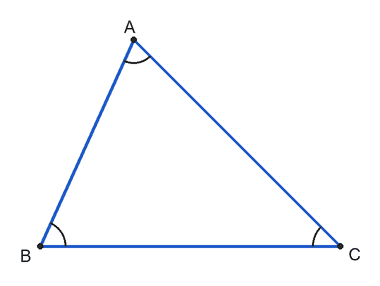
A, B and C are the angles of triangle ABC (as in the figure), so they add up to 180°:
A+B+C=180∘
Step 2 — Part (i): find half of A + B.
Taking C to the other side gives A+B=180∘−C; then we halve both sides:
2A+B=90∘−2C
Step 3 — Part (i): take the sine.
The angles 2A+B and 2C are complementary, and sin(90∘−θ)=cosθ:
sin(2A+B)=sin(90∘−2C)=cos(2C)
This proves part (i).
Step 4 — Part (ii): find half of B + C.
In the same way, B+C=180∘−A, and halving:
2B+C=90∘−2A
Step 5 — Part (ii): take the tangent.
Now we use tan(90∘−θ)=cotθ:
tan(2B+C)=tan(90∘−2A)=cot(2A)
This proves part (ii).
Watch out: Halve BOTH terms: 2180∘−C is 90∘−2C, not 90∘−C.
Therefore, (i) sin(2A+B)=cos(2C) and (ii) tan(2B+C)=cot(2A). Hence shown.
