
Question 871 markMCQEasy
For acute angles α and β, if α > β, then :
A : cos α > cos β B : tan α > tan β
C : sin α > sin β D : cot α > cot β
Which of the above statement/statements is/are true:
Confirming your payment
Sign up now and get 250 free tokens.
Trigonometrical Identities · Question 87 of 131
For acute angles α and β, if α > β, then :
A : cos α > cos β B : tan α > tan β
C : sin α > sin β D : cot α > cot β
Which of the above statement/statements is/are true:
(A) A and B
(B) B and C
(C) C and D
(D) D and A
Answer: (B) B and C
Concept: As an acute angle increases, its sine and tangent increase, while its cosine and cotangent decrease.
Step 1 — See it in a figure.
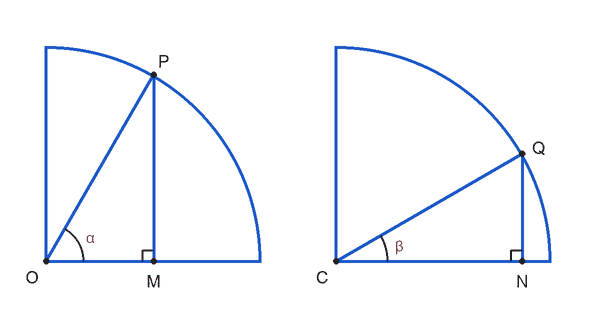
Take two quarter circles of radius 1. The radius OP makes the larger angle α with the base and CQ makes the smaller angle β; PM and QN are perpendicular to the base.
Step 2 — Compare sin and cos.
With hypotenuse 1, sin α = PM and sin β = QN, while cos α = OM and cos β = CN. The larger angle has the taller perpendicular and the shorter base: PM > QN, so sin α > sin β (statement C is true); OM < CN, so cos α < cos β (statement A is false).
Step 3 — Compare tan and cot.
The tangent is the perpendicular divided by the base. For α the perpendicular is bigger and the base is smaller, so tan α > tan β (statement B is true). The cotangent is the reciprocal of tan, so cot α < cot β (statement D is false).
Step 4 — Check with α = 60° and β = 30°.
The standard values agree:
So tan 60° > tan 30° and cos 60° < cos 30°, as expected; the true statements are B and C.
Watch out: The statements are named A, B, C and D, just like the options; read the option as a pair of statement names.
Why the other options are wrong:
Therefore, statements B and C are true, option (B).