
Opening your dashboard
Class 10 Maths Chapter 11: Geometric Progression Solutions
68 textbook questions with step-by-step answers, free to read, for ICSE 2026-27.
Get talked through Ch 11, not just shown the answer
Reading a finished solution is not the same as being able to do it. The AI tutor takes one question at a time and works it with you, in your own words, until you can.
- Ask it out loud, in your own words
- It gives you the next step, not the answer
- Stuck on part (ii)? Start there
68 questions with solutions
1–3 marks · Mixed difficulty
The first 11 solutions are on this page. This chapter is a long one, so the rest open on their own page to keep this one quick to load.
- 11 mark
Question 1
If the first term of a G.P. is 8 and its common ratio is −2. The term of this G.P. is :
Solve with AIAnswer
(A) −32
(B) 2
- Correct
(C) 32
(D) −2
Answer: (C) 32
Concept: In a geometric progression (G.P.) each term is the term before it multiplied by the same fixed number , called the common ratio. If the first term is , the terms are , so the term is .
Step 1 — Write down what is given.
The first term is and the common ratio is . We need the third term, so .
Step 2 — Use the formula for the term.
We put these values in . The power of is worked out first, and then we multiply.
Check: Multiplying by each time, the terms are , , , and the third one is 32. ✓
Watch out: Put a negative ratio in brackets. , but . An even power of a negative number is positive and an odd power is negative.
Why the other options are wrong:
- (A) −32: this takes as . A negative number squared is positive, so the term is , not .
- (B) 2: this divides 8 by , which is 4, instead of multiplying by it. That gives .
- (D) −2: is the common ratio itself, not a term. The terms are , , , and none of them is .
Therefore, the third term is 32, option (C).
- 21 mark
Question 2
The term of a G.P. is 16 and the term is 128, then its common ratio is equal to :
Solve with AIAnswer
- Correct
(A) 2
(B) −2
(C) 1
(D) −1
Answer: (A) 2
Concept: Each term of a G.P. can be written as , where is the first term and the common ratio. When two terms are given, we write both in this form and divide one equation by the other: cancels and only a power of is left.
Step 1 — Write both terms in the form .
Let the first term be and the common ratio be . The term is and the term is , so:
Step 2 — Divide (2) by (1).
Dividing the two equations removes , because appears once in each.
On the left the powers of are subtracted, , and on the right :
Since and a cube has only one real cube root:
Check: From (1), , so is 2 and the G.P. is : the term is 16 and the is 128. ✓
Watch out: An odd power has only one real root: if , then must be 2. An even power has two roots: if , then is 2 or .
Why the other options are wrong:
- (B) −2: , not 8. So with this ratio the term would be , not 128.
- (C) 1: with every term is the same, but here .
- (D) −1: , so the term would be , not 128.
Therefore, the common ratio is 2, option (A).
- 31 mark
Question 3
and are two consecutive terms of a G.P. The common ratio of the G.P. is :
Solve with AIAnswer
(A) 2
(B) 3
- Correct
(C)
(D)
Answer: (C)
Concept: The common ratio of a G.P. is any term divided by the term just before it, for example , and it is the same for every pair of neighbouring terms. With the first term and known, the term is .
Step 1 — Divide the later term by the earlier term.
The common ratio is a term divided by the term just before it. Here comes after :
Step 2 — Cancel the common factor.
We took 3 out of the numerator and 2 out of the denominator, which leaves the same bracket in both, so it cancels. This is allowed because : if were , both terms would be 0, and the terms of a G.P. are never 0.
Check: With , the terms are 4 and 6, and . ✓
Watch out: The common ratio is a term divided by the term before it (), not the earlier term divided by the later one.
Why the other options are wrong:
- (A) 2: 2 is only the number taken out of the first term, . It is not the ratio of the two terms.
- (B) 3: 3 is only the number taken out of the second term, . It is not the ratio of the two terms.
- (D) : this is the earlier term divided by the later term, , which is the ratio upside down.
Therefore, the common ratio is , option (C).
- 41 mark
Question 4
The third term of a G.P. is 3. The product of its first five terms is :
Solve with AIAnswer
(A) 15
(B)
- Correct
(C)
(D)
Answer: (C)
Concept: In a geometric progression (G.P.) each term is the term before it multiplied by the same fixed number , called the common ratio. If the first term is , the terms are , so the term is .
Step 1 — Write the first five terms.
Let the first term be and the common ratio be . The first five terms are , , , and , and the third term is .
Step 2 — Multiply the five terms.
There are five factors of , and the powers of add up to :
The last line uses : the product is the third term raised to the power 5.

Step 3 — Put in the third term.
Since , we replace by 3:
Check: The G.P. has third term 3, and the product of its five terms is
Watch out: The five terms are multiplied, so the third term is raised to the power 5; it is not multiplied by 5.
Why the other options are wrong:
- (A) 15: multiplies the third term by 5 instead of raising it to the power 5.
- (B) : copies the pattern of the sum of an A.P. Here the terms are multiplied, not added.
- (D) : the base and the power are swapped: , but the product is .
Therefore, the product of the first five terms is , option (C).
- 51 mark
Question 5
The term of a G.P. is 192 and its common ratio is 2, then the first term of the G.P. is :
Solve with AIAnswer
(A) 3
(B)
(C)
- Correct
(D)
Answer: (D)
Concept: In a geometric progression (G.P.) each term is the term before it multiplied by the same fixed number , called the common ratio. If the first term is , the terms are , so the term is .
Step 1 — Write the term in the form .
With , the power of is , which is 7, and is 2:
Since :
Step 2 — Solve for .
We divide both sides by 128 and cancel the fraction by 64:
Check: We put back into the term:
Watch out: The power of in is , not : the first term has no factor at all.
Why the other options are wrong:
- (A) 3: this divides 192 by , which is 64, one power of 2 too few. Then the term would be .
- (B) : this divides the wrong way round with : . Then the term would be , not 192.
- (C) : this divides the wrong way round: , the reciprocal of the answer. Then the term would be .
Therefore, the first term is , option (D).
- 63 marks
Question 6
Find the term of the series : 1, 4, 16, 64, ……
Solve with AIWritten solution
Solution:
Concept: In a geometric progression (G.P.) each term is the term before it multiplied by the same fixed number , called the common ratio. If the first term is , the terms are , so the term is .
Given: The series ; we need its term.
Step 1 — Find the first term and the common ratio.
The first term is . The common ratio is the second term divided by the first:
The other ratios agree, and , so the series is a G.P.
Step 2 — Find the term.
We put , and in the formula for . The power of is , which is 8:
Check: Multiplying by 4 each time: 1, 4, 16, 64, 256, 1024, 4096, 16384, 65536. The ninth number is 65536. ✓
Watch out: The power of in is , not : the first term has no factor at all.
Therefore, the term is 65536.
- 73 marks
Question 7
Find the seventh term of the G.P. :
Solve with AIWritten solution
Solution:
Concept: In a geometric progression (G.P.) each term is the term before it multiplied by the same fixed number , called the common ratio. If the first term is , the terms are , so the term is .
Given: The G.P. ; we need its seventh term.
Step 1 — Find the first term and the common ratio.
The first term is , and the common ratio is the second term divided by the first:
The next ratio agrees: .
Step 2 — Find the seventh term.
We put , and in the formula for . A power of with an even index is easy, because :
Check: The terms are , and the seventh is 27. ✓
Watch out: is , not : each pair of 's multiplies to 3.
Therefore, the seventh term is 27.
- 83 marks
Question 8
Find the term of the sequence :
Solve with AIWritten solution
Solution:
Concept: In a geometric progression (G.P.) each term is the term before it multiplied by the same fixed number , called the common ratio. If the first term is , the terms are , so the term is .
Given: The sequence ; we need its term.
Step 1 — Write the mixed number as a fraction.
It is easier to divide fractions, so we write . The sequence is and its first term is .
Step 2 — Find the common ratio.
We divide the second term by the first; dividing by a fraction means multiplying by its reciprocal:
The next ratio agrees: .
Step 3 — Find the term.
We put , and in the formula for . The power of is 7, and :
Check: Doubling each time: . ✓
Watch out: The power of in is , not : the first term has no factor at all.
Therefore, the term is 96.
- 93 marks
Question 9
Find the next three terms of the sequence :
Solve with AIWritten solution
Solution:
Concept: The common ratio of a G.P. is any term divided by the term just before it, for example , and it is the same for every pair of neighbouring terms. With the first term and known, the term is .
Given: The sequence ; we need the , and terms.
Step 1 — Find the common ratio.
We divide the second term by the first; since , the quotient is :
The next ratio agrees: .
Step 2 — Find the term.
Each new term is the term before it multiplied by . The term is :
Step 3 — Find the term.
We multiply the term by :
Step 4 — Find the term.
We multiply the term by , and :
Check: The terms are the powers of , so the sixth term is
Watch out: is , not : the two 's multiply to 5.
Therefore, the next three terms are 25, and 125.
- 103 marks
Question 10
Find the seventh term of the G.P. :
Solve with AIWritten solution
Solution:
Concept: In a geometric progression (G.P.) each term is the term before it multiplied by the same fixed number , called the common ratio. If the first term is , the terms are , so the term is .
Given: The G.P. ; we need its seventh term.
Step 1 — Find the common ratio.
We divide the second term by the first, then rationalise: multiply the top and the bottom by , because is , that is, 2.
The next ratio agrees: .
Step 2 — Use the second term to shorten the work.
The seventh term is . The second term is 1, and is the same as , so the seventh term is simply :
Step 3 — Find .
We square , using :
Step 4 — Find .
We square , using :
Step 5 — Find .
We multiply by and expand the brackets: .
Check: , so the terms shrink quickly; , a small positive number, as expected. ✓
Watch out: Rationalise the ratio first. Working with to the sixth power is much harder than with .
Therefore, the seventh term is .
- 113 marks
Question 11
Find the next two terms of the series :
Solve with AIWritten solution
Solution:
Concept: The common ratio of a G.P. is any term divided by the term just before it, for example , and it is the same for every pair of neighbouring terms. With the first term and known, the term is .
Given: The series ; we need its next two terms.
Step 1 — Find the common ratio.
The terms of the series are . We divide the second term by the first:
The other ratios agree: and .
Step 2 — Find the next two terms.
Each new term is the one before it multiplied by . A negative times a negative is positive:
and a positive times a negative is negative:
Check: The signs alternate as they should with a negative ratio, and the series continues . ✓
Watch out: The minus signs belong to the terms. The ratio is , not 3, so the signs keep alternating.
Therefore, the next two terms are 162 and , so the series continues .
- 123 marks
Question 12
Which term of the G.P. : is ?
- 133 marks
Question 13
The fifth term of a G.P. is 81 and its second term is 24. Find the geometric progression.
- 143 marks
Question 14
Fourth and seventh terms of a G.P. are and respectively. Find the G.P.
- 153 marks
Question 15
If the first and the third terms of a G.P. are 2 and 8 respectively, find its second term.
- 163 marks
Question 16
The product of and terms of a G.P. is 243. If its term is 3, find its term.
- 173 marks
Question 17
Find the geometric progression with fourth term = 54 and seventh term = 1458.
- 183 marks
Question 18
Second term of a geometric progression is 6 and its fifth term is 9 times of its third term. Find the geometric progression. Consider that each term of the G.P. is positive.
- 193 marks
Question 19
The fourth term, the seventh term and the last term of a geometric progression are 10, 80 and 2560 respectively. Find its first term, common ratio and number of terms.
- 203 marks
Question 20
If the fourth and ninth terms of a G.P. are 54 and 13122 respectively, find the G.P. Also, find its general term.
- 213 marks
Question 21
The fifth, eighth and eleventh terms of a geometric progression are , and respectively. Show that : .
- 223 marks
Question 22
Find the seventh term from the end of the series : .
- 233 marks
Question 23
Find the third term from the end of the G.P. .
- 243 marks
Question 24
For the G.P. ; find the product of fourth term from the beginning and the fourth term from the end.
- 253 marks
Question 25
If , , are in G.P. and , , , , are in A.P., prove that :
(i) (ii) .
- 263 marks
Question 26
If , and are in A.P. and also in G.P., show that : .
- 271 mark
Question 27
The sum of first four terms of the G.P. 2, 6, 18, ……, is :
- 281 mark
Question 28
The term of a G.P. is 54 and its term is 1458, the common ratio of this GP is :
- 291 mark
Question 29
The geometric mean between 8 and 32 is :
- 301 mark
Question 30
The sum of three terms (numbers) of a G.P. is and their product is 1; the numbers are :
- 311 mark
Question 31
The sum of 20 terms of the G.P. 10, 20, 40, …… is :
- 323 marks
Question 32
Find the sum of G.P. :
(i) 1 + 3 + 9 + 27 + …… to 12 terms.
(ii) 0·3 + 0·03 + 0·003 + 0·0003 + …… to 8 terms.
(iii) to 9 terms.
- 333 marks
Question 33
How many terms of the geometric progression 1 + 4 + 16 + 64 + …… must be added to get sum equal to 5461 ?
- 343 marks
Question 34
The first term of a G.P. is 27 and its term is . Find the sum of its first 10 terms.
- 353 marks
Question 35
A boy spends ₹ 10 on first day, ₹ 20 on second day, ₹ 40 on third day and so on. Find how much, in all, will he spend in 12 days ?
- 363 marks
Question 36
The and the terms of a G.P. are and respectively. Find the sum of terms of this G.P.
- 373 marks
Question 37
A geometric progression has common ratio = 3 and last term = 486. If the sum of its terms is 728; find its first term.
- 383 marks
Question 38
Find the sum of G.P. : 3, 6, 12, ……, 1536.
- 393 marks
Question 39
How many terms of the series 2 + 6 + 18 + …… must be taken to make the sum equal to 728 ?
- 403 marks
Question 40
In a G.P., the ratio between the sum of first three terms and that of the first six terms is 125 : 152. Find its common ratio.
- 413 marks
Question 41
If the sum of is 255, find the value of .
- 423 marks
Question 42
Find the geometric mean between :
(i) and (ii) 14 and (iii) and
- 433 marks
Question 43
The sum of three numbers in G.P. is and their product is 1. Find the numbers.
- 443 marks
Question 44
The first term of a G.P. is −3 and the square of the second term is equal to its term. Find its term.
- 453 marks
Question 45
Find the term of the G.P.
- 463 marks
Question 46
The first two terms of a G.P. are 125 and 25 respectively. Find the and the terms of the G.P.
- 473 marks
Question 47
Find the sum of the sequence upto 8 terms.
- 483 marks
Question 48
The first term of a G.P. is 27. If the term be , what will be the sum of 10 terms ?
- 493 marks
Question 49
Find a G.P. for which the sum of first two terms is −4 and the fifth term is 4 times the third term.
- 501 mark
Question 50
−1, and −1 are three consecutive terms of a G.P., then
- 2.
Which of the following is valid ?
- 511 mark
Question 51
, 10 and 4 are in G.P. The value of is :
- 521 mark
Question 52
The common ratio of a G.P. is 2 and its term is 48. The first term is :
- 531 mark
Question 53
Three terms are in G.P., whose product is 27. The middle term is :
- 541 mark
Question 54
The common ratio of a G.P., whose term is 27 and term is 243; is :
- 551 mark
Question 55
The third term of a G.P. = 18, the product of its first five terms is :
- 561 mark
Question 56
G.P. :
Assertion (A) : term of the given G.P. is .
Reason (R) : If for a G.P., the first term is , the common ratio is and number of terms , then sum of first terms for all .
- 571 mark
Question 57
For a G.P., its fourth term , seventh term and tenth term .
Assertion (A) : , and are in GP.
Reason (R) :
- 581 mark
Question 58
G.P. :
Statement (1) : Product of term from beginning and term from end of the G.P. is −1152.
Statement (2) : In a G.P., product of term from beginning and term from end is term + last term
- 591 mark
Question 59
In a G.P., common ratio , first term and last term .
Statement (1) : The number of terms in this G.P. .
Statement (2) :
- 603 marks
Question 60
The and the terms of a G.P. are 32 and 256 respectively. Find its first term and the common ratio.
- 613 marks
Question 61
The third term of a G.P. is greater than its first term by 9 whereas its second term is greater than the fourth term by 18. Find the G.P.
- 623 marks
Question 62
, , , G are four consecutive terms of a G.P. Find the value of G.
- 633 marks
Question 63
The third term of a G.P. is 2. Find the product of the first five terms of this G.P.
- 643 marks
Question 64
The , and terms of a G.P. are , and respectively. Show that , and are in G.P.
- 653 marks
Question 65
Which term of the G.P. is ?
- 663 marks
Question 66
Find the term of a G.P., if its common ratio is 2 and term is 768.
- 673 marks
Question 67
In a G.P., the term is 48 and term is 384. Find its term.
- 683 marks
Question 68
, and are three consecutive terms of a G.P. Find the value(s) of .
What Class 10 Maths Ch 11 covers
The sections of the chapter, in the order the book takes them. Every question above comes from one of these.
- 01Geometric Progression
- 02General Term of a Geometric Progression
- 03Properties of Geometric Progression
- 04Sum of n Terms of a G.P.
- 05Geometric Mean Between Numbers a and b
More ways to study this chapter
The same chapter asked three other ways. Practise it, revise it, and see what the board has set on Ch 11 before.
- Competency-Based Questions (CBQ)Case study questions: a situation, and the part of the chapter that answers it.40questionsOpen
- Previous Year QuestionsQuestions that have actually appeared in board papers, each tagged with its year.9questionsOpen
- Practice QuestionsExtra questions per chapter, for when one attempt at a method is not enough.41questionsOpen
Ch 11 in past ICSE papers
The same chapter as the board has actually asked it. These are worded differently from the textbook exercise, which is the point of reading them.
- 13 marks
Board paper question 1
The term of a G.P. is 16 and the term is 128. Find the first term and common ratio of the series.
Solve with AIWritten solution
Solution:
Concept: Each term of a G.P. can be written as , where is the first term and the common ratio. When two terms are given, we write both in this form and divide one equation by the other: cancels and only a power of is left.
Step 1 — Write the two given terms.
Each term is , so we write the two given terms in this form.
Step 2 — Divide to find r.
We divide (2) by (1). The first term cancels, and on the left the powers of are subtracted ().
Simplifying both sides (128 ÷ 16 is 8):
The cube root of 8 is 2 (because ), and an odd power has only one real root:
The figure shows the three equal jumps from the 4th term to the 7th term.

Step 3 — Find a.
We put in equation (1).
Since is 8:
Dividing both sides by 8:
Check: The 4th term is and the 7th term is , as given.
Watch out: An odd power has only one real root: if , then must be 2. An even power has two roots: if , then is 2 or . The power of in is , not : the first term has no factor at all.
Therefore, the first term is 2 and the common ratio is 2.
- 23 marks
Board paper question 2
The first and last term of a Geometrical Progression (G.P.) are 3 and 96 respectively. If the common ratio is 2, find:
(i) 'n' the number of terms of the G.P.
(ii) Sum of the n terms.
Solve with AIWritten solution
Solution:
Concept: In a geometric progression (G.P.) each term is the term before it multiplied by the same fixed number , called the common ratio. If the first term is , the terms are , so the term is . The sum of the first terms of a G.P. with first term and common ratio () is . The same sum can also be written as , which is easier to use when is less than 1.
Step 1 — Part (i): use the last term.
The last term 96 is the term, so equals 96, where is 3 and is 2.
Dividing both sides by 3:
Writing 32 as a power of 2, since is 32:
The bases are the same, so the powers are equal:
Adding 1 to both sides:
The figure shows the six terms, doubling from 3 to 96.
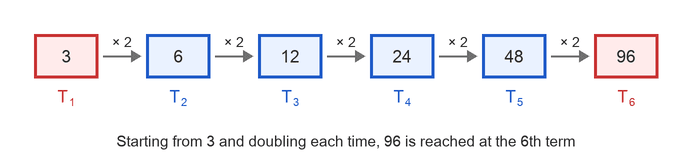
Step 2 — Part (ii): find the sum.
We use the sum formula , the convenient form because is greater than 1, with , and .
Check: Adding the six terms one by one gives the same value.
Watch out: The power of in is , not : the first term has no factor at all. In the power of is itself (the number of terms), not as in the term.
Therefore, (i) ; (ii) the sum of the 6 terms is 189.
- 34 marks
Board paper question 3
The , and the last term of a geometric progression are 10, 40 and 640 respectively. If the common ratio is positive, find the first term, common ratio and the number of terms of the series.
Solve with AIWritten solution
Solution:
Concept: Each term of a G.P. can be written as , where is the first term and the common ratio. When two terms are given, we write both in this form and divide one equation by the other: cancels and only a power of is left.
Step 1 — Write the two given terms.
Each term is , so the 4th and 6th terms give two equations.
Step 2 — Divide to find r.
We divide (2) by (1). The first term cancels and the powers of are subtracted ().
Simplifying both sides:
So or . The question says the common ratio is positive, so we keep only the positive root:
Step 3 — Find a.
We put in equation (1).
Since is 8:
Dividing both sides by 8 and simplifying:
Step 4 — Find the number of terms.
The last term 640 is the term.
Multiplying both sides by :
Writing 512 as a power of 2, since is 512:
The bases are the same, so the powers are equal:
Adding 1 to both sides:
The figure shows all ten terms.

Check: The 4th term is , the 6th is , and the 10th is , as given.
Watch out: has two roots, and . Check each one, and keep both unless the question rules one out. Here the question rules out the negative one.
Therefore, the first term is , the common ratio is 2, and there are 10 terms.
- 44 marks
Board paper question 4
15, 30, 60, 120 ...... are in G.P. (Geometric Progression).
(a) Find the term of this G.P. in terms of .
(b) How many terms of the above G.P. will give the sum 945 ?
Solve with AIWritten solution
Solution:
Concept: In a geometric progression (G.P.) each term is the term before it multiplied by the same fixed number , called the common ratio. If the first term is , the terms are , so the term is . The sum of the first terms of a G.P. with first term and common ratio () is . The same sum can also be written as , which is easier to use when is less than 1.
Step 1 — Find a and r.
The first term is . The common ratio is a term divided by the term before it.
Each later pair gives the same ratio ( is 2), so it is a G.P.
Step 2 — Part (a): write the nth term.
We put and in .
Step 3 — Part (b): set the sum equal to 945.
We use the sum formula because is greater than 1.
The denominator is 1:
Dividing both sides by 15:
Adding 1 to both sides:
Writing 64 as a power of 2, since is 64:
The bases are the same, so the powers are equal:
The figure shows the six terms.

Check: Adding the first six terms gives the required sum.
Watch out: In the power of is itself (the number of terms), not as in the term.
Therefore, (a) ; (b) 6 terms give the sum 945.
- 53 marks
Board paper question 5
If 1701 is the term of the Geometric Progression (G.P.) 7, 21, 63......, find :
(a) the value of ''
(b) hence find the sum of the '' terms of the G.P.
Solve with AIWritten solution
Solution:
Concept: In a geometric progression (G.P.) each term is the term before it multiplied by the same fixed number , called the common ratio. If the first term is , the terms are , so the term is . The sum of the first terms of a G.P. with first term and common ratio () is . The same sum can also be written as , which is easier to use when is less than 1.
Step 1 — Find a and r.
The first term is , and the common ratio is a term divided by the term before it.
Step 2 — Part (a): find n.
The term is 1701, so .
Dividing both sides by 7:
Writing 243 as a power of 3, since is 243:
The bases are the same, so the powers are equal:
Adding 1 to both sides:
The figure shows the six terms.
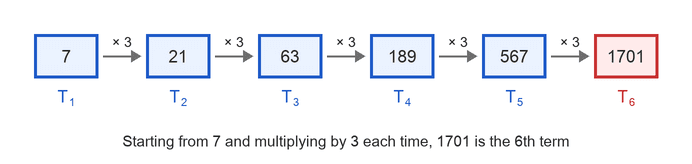
Step 3 — Part (b): find the sum.
We use the sum formula with , and .
Check: Adding the six terms one by one gives the same value.
Watch out: The power of in is , not : the first term has no factor at all. In the power of is itself (the number of terms), not as in the term.
Therefore, (a) ; (b) the sum of the 6 terms is 2548.
- 63 marks
Board paper question 6
If the term of a series in Geometric Progression (G.P.) is 32 and the term is 256, find the:
(a) first term and the common ratio.
(b) sum of its first 10 terms.
Solve with AIWritten solution
Solution:
Concept: Each term of a G.P. can be written as , where is the first term and the common ratio. When two terms are given, we write both in this form and divide one equation by the other: cancels and only a power of is left. The sum of the first terms of a G.P. with first term and common ratio () is . The same sum can also be written as , which is easier to use when is less than 1.
Step 1 — Write the two given terms.
Each term is , so we write the two given terms in this form.
Step 2 — Divide to find r.
We divide (2) by (1). The first term cancels, and on the left the powers of are subtracted ().
Simplifying both sides (256 ÷ 32 is 8):
The cube root of 8 is 2, and an odd power has only one real root:
The figure shows the three equal jumps from the 6th term to the 9th term.

Step 3 — Find a.
We put in equation (1).
Since is 32:
Dividing both sides by 32:
Step 4 — Part (b): find the sum of 10 terms.
We use the sum formula with , and .
Check: The ten terms are 1, 2, 4, 8, 16, 32, 64, 128, 256, 512. The 6th is 32 and the 9th is 256, as given, and they add up to 1023.
Watch out: An odd power has only one real root: if , then must be 2. An even power has two roots: if , then is 2 or . In the power of is itself (the number of terms), not as in the term.
Therefore, (a) the first term is 1 and the common ratio is 2; (b) the sum of the first 10 terms is 1023.
All 9 board paper questions for this chapter, solved the same way.
Class 10 Maths Ch 11 questions students ask
How many questions are there in Class 10 Maths Ch 11?
68 questions. Every one is solved step by step on this page.
Are these Class 10 Maths solutions free?
Yes. Every question and its full working is free to read, with no account needed.
Can I download the Class 10 Maths Ch 11 solutions as a PDF?
There is no PDF to download. Every solution is on this page instead, which means it is searchable, always the current syllabus, and readable on a phone. Use your browser's print option if you want it on paper.