
Opening your dashboard
Class 10 Maths Chapter 11 Geometric Progression: Previous Year Questions
9 questions on Chapter 11, each solved step by step. Class 10 Maths, ICSE 2026-27.
9 questions with solutions
1–4 marks · Mixed difficulty
- 13 marks
Question 1
The term of a G.P. is 16 and the term is 128. Find the first term and common ratio of the series.
Solve with AIWritten solution
Solution:
Concept: Each term of a G.P. can be written as , where is the first term and the common ratio. When two terms are given, we write both in this form and divide one equation by the other: cancels and only a power of is left.
Step 1 — Write the two given terms.
Each term is , so we write the two given terms in this form.
Step 2 — Divide to find r.
We divide (2) by (1). The first term cancels, and on the left the powers of are subtracted ().
Simplifying both sides (128 ÷ 16 is 8):
The cube root of 8 is 2 (because ), and an odd power has only one real root:
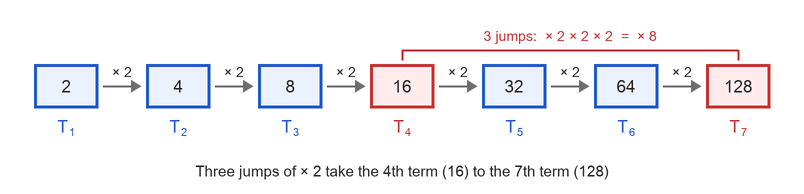
The figure shows the three equal jumps from the 4th term to the 7th term.

Step 3 — Find a.
We put in equation (1).
Since is 8:
Dividing both sides by 8:
Check: The 4th term is and the 7th term is , as given.
Watch out: An odd power has only one real root: if , then must be 2. An even power has two roots: if , then is 2 or . The power of in is , not : the first term has no factor at all.
Therefore, the first term is 2 and the common ratio is 2.
- 23 marks
Question 2
The first and last term of a Geometrical Progression (G.P.) are 3 and 96 respectively. If the common ratio is 2, find:
(i) 'n' the number of terms of the G.P.
(ii) Sum of the n terms.
Solve with AIWritten solution
Solution:
Concept: In a geometric progression (G.P.) each term is the term before it multiplied by the same fixed number , called the common ratio. If the first term is , the terms are , so the term is . The sum of the first terms of a G.P. with first term and common ratio () is . The same sum can also be written as , which is easier to use when is less than 1.
Step 1 — Part (i): use the last term.
The last term 96 is the term, so equals 96, where is 3 and is 2.
Dividing both sides by 3:
Writing 32 as a power of 2, since is 32:
The bases are the same, so the powers are equal:
Adding 1 to both sides:
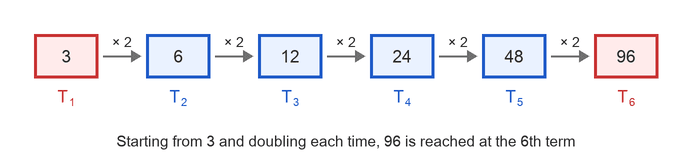
The figure shows the six terms, doubling from 3 to 96.
Step 2 — Part (ii): find the sum.
We use the sum formula , the convenient form because is greater than 1, with , and .
Check: Adding the six terms one by one gives the same value.
Watch out: The power of in is , not : the first term has no factor at all. In the power of is itself (the number of terms), not as in the term.
Therefore, (i) ; (ii) the sum of the 6 terms is 189.
- 34 marks
Question 3
The , and the last term of a geometric progression are 10, 40 and 640 respectively. If the common ratio is positive, find the first term, common ratio and the number of terms of the series.
Solve with AIWritten solution
Solution:
Concept: Each term of a G.P. can be written as , where is the first term and the common ratio. When two terms are given, we write both in this form and divide one equation by the other: cancels and only a power of is left.
Step 1 — Write the two given terms.
Each term is , so the 4th and 6th terms give two equations.
Step 2 — Divide to find r.
We divide (2) by (1). The first term cancels and the powers of are subtracted ().
Simplifying both sides:
So or . The question says the common ratio is positive, so we keep only the positive root:
Step 3 — Find a.
We put in equation (1).
Since is 8:
Dividing both sides by 8 and simplifying:
Step 4 — Find the number of terms.
The last term 640 is the term.
Multiplying both sides by :
Writing 512 as a power of 2, since is 512:
The bases are the same, so the powers are equal:
Adding 1 to both sides:
The figure shows all ten terms.

Check: The 4th term is , the 6th is , and the 10th is , as given.
Watch out: has two roots, and . Check each one, and keep both unless the question rules one out. Here the question rules out the negative one.
Therefore, the first term is , the common ratio is 2, and there are 10 terms.
- 44 marks
Question 4
15, 30, 60, 120 ...... are in G.P. (Geometric Progression).
(a) Find the term of this G.P. in terms of .
(b) How many terms of the above G.P. will give the sum 945 ?
Solve with AIWritten solution
Solution:
Concept: In a geometric progression (G.P.) each term is the term before it multiplied by the same fixed number , called the common ratio. If the first term is , the terms are , so the term is . The sum of the first terms of a G.P. with first term and common ratio () is . The same sum can also be written as , which is easier to use when is less than 1.
Step 1 — Find a and r.
The first term is . The common ratio is a term divided by the term before it.
Each later pair gives the same ratio ( is 2), so it is a G.P.
Step 2 — Part (a): write the nth term.
We put and in .
Step 3 — Part (b): set the sum equal to 945.
We use the sum formula because is greater than 1.
The denominator is 1:
Dividing both sides by 15:
Adding 1 to both sides:
Writing 64 as a power of 2, since is 64:
The bases are the same, so the powers are equal:
The figure shows the six terms.

Check: Adding the first six terms gives the required sum.
Watch out: In the power of is itself (the number of terms), not as in the term.
Therefore, (a) ; (b) 6 terms give the sum 945.
- 53 marks
Question 5
If 1701 is the term of the Geometric Progression (G.P.) 7, 21, 63......, find :
(a) the value of ''
(b) hence find the sum of the '' terms of the G.P.
Solve with AIWritten solution
Solution:
Concept: In a geometric progression (G.P.) each term is the term before it multiplied by the same fixed number , called the common ratio. If the first term is , the terms are , so the term is . The sum of the first terms of a G.P. with first term and common ratio () is . The same sum can also be written as , which is easier to use when is less than 1.
Step 1 — Find a and r.
The first term is , and the common ratio is a term divided by the term before it.
Step 2 — Part (a): find n.
The term is 1701, so .
Dividing both sides by 7:
Writing 243 as a power of 3, since is 243:
The bases are the same, so the powers are equal:
Adding 1 to both sides:
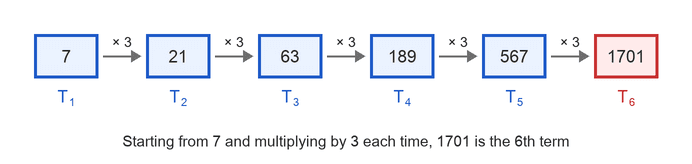
The figure shows the six terms.
Step 3 — Part (b): find the sum.
We use the sum formula with , and .
Check: Adding the six terms one by one gives the same value.
Watch out: The power of in is , not : the first term has no factor at all. In the power of is itself (the number of terms), not as in the term.
Therefore, (a) ; (b) the sum of the 6 terms is 2548.
- 63 marks
Question 6
If the term of a series in Geometric Progression (G.P.) is 32 and the term is 256, find the:
(a) first term and the common ratio.
(b) sum of its first 10 terms.
Solve with AIWritten solution
Solution:
Concept: Each term of a G.P. can be written as , where is the first term and the common ratio. When two terms are given, we write both in this form and divide one equation by the other: cancels and only a power of is left. The sum of the first terms of a G.P. with first term and common ratio () is . The same sum can also be written as , which is easier to use when is less than 1.
Step 1 — Write the two given terms.
Each term is , so we write the two given terms in this form.
Step 2 — Divide to find r.
We divide (2) by (1). The first term cancels, and on the left the powers of are subtracted ().
Simplifying both sides (256 ÷ 32 is 8):
The cube root of 8 is 2, and an odd power has only one real root:
The figure shows the three equal jumps from the 6th term to the 9th term.

Step 3 — Find a.
We put in equation (1).
Since is 32:
Dividing both sides by 32:
Step 4 — Part (b): find the sum of 10 terms.
We use the sum formula with , and .
Check: The ten terms are 1, 2, 4, 8, 16, 32, 64, 128, 256, 512. The 6th is 32 and the 9th is 256, as given, and they add up to 1023.
Watch out: An odd power has only one real root: if , then must be 2. An even power has two roots: if , then is 2 or . In the power of is itself (the number of terms), not as in the term.
Therefore, (a) the first term is 1 and the common ratio is 2; (b) the sum of the first 10 terms is 1023.
- 71 mark
Question 7
Assertion (A): The term of a Geometric Progression (G.P.) is a positive term.
Reason (R): The value of is always positive.
Solve with AIAnswer
(A) (A) is true and (R) is false.
(B) (A) is false and (R) is true.
- Correct
(C) Both (A) and (R) are true and (R) is the correct explanation of (A).
(D) Both (A) and (R) are true but (R) is not the correct explanation of (A).
Answer: (C) Both (A) and (R) are true and (R) is the correct explanation of (A).
Concept: In an Assertion–Reason question we judge the Assertion (A) and the Reason (R) separately, true or false, and then, if both are true, decide whether R correctly explains A. In a geometric progression (G.P.) each term is the term before it multiplied by the same fixed number , called the common ratio. If the first term is , the terms are , so the term is .
Step 1 — Find the first term and the ratio.
The first term is , and the common ratio is a term divided by the term before it.
Step 2 — Judge the Assertion.
The 9th term is . We put and .
1536 is positive, so A is true. The figure shows the signs alternating: every odd-numbered term is positive.

Step 3 — Judge the Reason.
is multiplied by itself 8 times. The 8 minus signs pair off into 4 pluses, so the result is positive ( is 256). R is true.
Step 4 — Does R explain A?
and 6 is positive, so the sign of the 9th term is decided only by the sign of . R is therefore exactly the reason why the 9th term is positive.
Watch out: Put a negative ratio in brackets. , but . An even power of a negative number is positive and an odd power is negative.
Why the other options are wrong:
- (A) (A) is true and (R) is false: it calls R false, but is 256, which is positive.
- (B) (A) is false and (R) is true: it calls A false, but the 9th term is 1536, which is positive.
- (D) Both (A) and (R) are true but (R) is not the correct explanation of (A): the 9th term is , so the sign of is exactly what makes it positive; R does explain A.
Therefore, both (A) and (R) are true and (R) is the correct explanation of (A), option (C).
- 83 marks
Question 8
The fourth term of a Geometric Progression (G.P.) is 16 and its seventh term is 128. Find its:
(a) common ratio
(b) first term
Solve with AIWritten solution
Solution:
Concept: Each term of a G.P. can be written as , where is the first term and the common ratio. When two terms are given, we write both in this form and divide one equation by the other: cancels and only a power of is left.
Step 1 — Write the two given terms.
Each term is , so we write the two given terms in this form.
Step 2 — Part (a): divide to find r.
We divide (2) by (1). The first term cancels, and on the left the powers of are subtracted ().
Simplifying both sides (128 ÷ 16 is 8):
The cube root of 8 is 2, and an odd power has only one real root:
Step 3 — Part (b): find a.
We put in equation (1).
Since is 8:
Dividing both sides by 8:
The figure shows the G.P. from the first term 2 to the 7th term 128.
Check: The 4th term is and the 7th term is , as given.
Watch out: An odd power has only one real root: if , then must be 2. An even power has two roots: if , then is 2 or . The power of in is , not : the first term has no factor at all.
Therefore, (a) the common ratio is 2; (b) the first term is 2.
- 93 marks
Question 9
The sum of first three terms of a Geometric Progression (G.P.) is and their product is 27. Given , find its:
(a) common ratio.
(b) first three terms.
Solve with AIWritten solution
Solution:
Concept: Three unknown numbers in G.P. are best taken as , and . Their product is , because the 's cancel, so the product gives at once.
Step 1 — Name the three terms.
We take the three terms as , and , so that cancels in their product.
Step 2 — Use the product.
The product of the three terms is 27.
The 's cancel:
Taking the cube root (since is 27):
Step 3 — Use the sum.
The sum of the three terms is . We put .
Multiplying every term by to clear the fractions:
Taking all the terms to one side:
Dividing every term by 3:
Splitting the middle term () and factorising:
So or .
Step 4 — Part (a): choose the ratio.
The question gives , so we reject and keep the other root.
Step 5 — Part (b): write the three terms.
We put and into , and . Dividing by is the same as multiplying by 2.
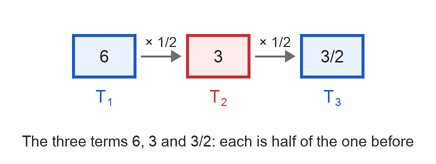
So the terms are 6, 3 and . The figure shows each term as half of the one before it.
Check: The three terms must give the stated sum and product.
Watch out: also satisfies the equations (it gives the same terms in reverse order, ), but the question says , so only is accepted.
Therefore, (a) the common ratio is ; (b) the first three terms are 6, 3 and .