Solution:
Concept: Electronegativity is the tendency of an atom to attract a shared pair of electrons towards itself. If the two bonded atoms have equal electronegativity, the pair is shared equally and the bond is non-polar; if one is more electronegative, it pulls the pair closer, gets a partial negative charge (δ−) and the other a partial positive charge (δ+), and the bond is polar. The electronegativity (E.N.) difference decides the type of bond: the bigger the difference, the more one atom pulls the electrons.
Step 1 — Zero difference.
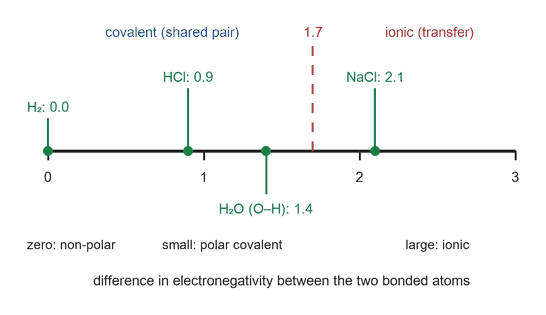
(a) (i) When the E.N. difference is zero, the pair is shared equally, giving a non-polar covalent bond (e.g. H₂, Cl₂).
Step 2 — Small difference.
(ii) When the E.N. difference is small, the pair is shared unequally, giving a polar covalent bond (e.g. HCl, difference 0.9).
Step 3 — Large difference.
(iii) When the E.N. difference is large (more than about 1.7), the electron is transferred completely, giving an electrovalent (ionic) bond (e.g. NaCl, difference 2.1).
Step 4 — Water.
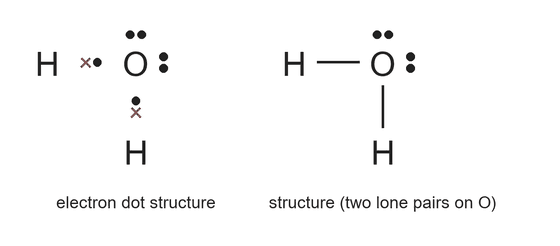
(b) (i) Oxygen (2, 6) shares one pair with each of two hydrogen atoms and keeps two lone pairs. Oxygen (3.5) is more electronegative than hydrogen (2.1), so the bonds are polar covalent.
Step 5 — Calcium oxide.
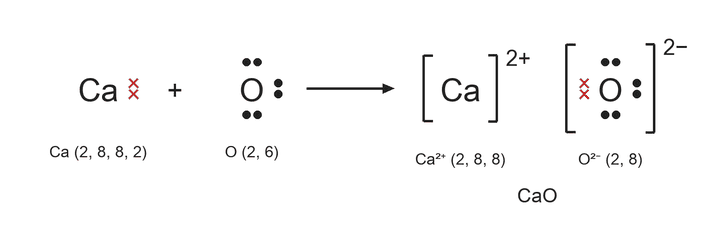
(ii) Calcium (2, 8, 8, 2) transfers its two valence electrons to oxygen (2, 6), so the bond is electrovalent (ionic).
Ca→Ca2++2e−
O+2e−→O2−
Watch out: The dividing value 1.7 is only a guide; the larger the difference, the more ionic the bond.
Therefore, (a) zero E.N. difference gives a non-polar covalent bond, a small difference a polar covalent bond and a large difference an electrovalent bond; (b) water has polar covalent bonds and calcium oxide has an electrovalent bond, as shown in the Lewis structures.
