Solution:
Concept: Electrovalent compounds are made of ions held by strong electrostatic forces in a crystal lattice; covalent compounds are made of molecules, and the forces between molecules are weak. Almost every difference in their properties (state, melting and boiling points, solubility, conductivity) follows from this. An electric current passes through a liquid or a solution only if it contains ions that are free to move. Positive ions (cations) move to the cathode (negative electrode) and negative ions (anions) move to the anode (positive electrode).
Step 1 — Conductivity of electrovalent compounds.
(a) An electric current through a compound is carried by moving ions. In the molten state or in aqueous solution, electrovalent compounds have free mobile ions, so they conduct. (In the solid state the ions are fixed in the lattice, so the solid does not conduct.)
Step 2 — Melting and boiling points.
(b) In electrovalent compounds the ions are held by strong electrostatic forces; much energy is needed to separate them, so the melting and boiling points are high. Covalent compounds consist of molecules held by weak forces of attraction, which are easily overcome, so their melting and boiling points are low.
Step 3 — Solubility in water.
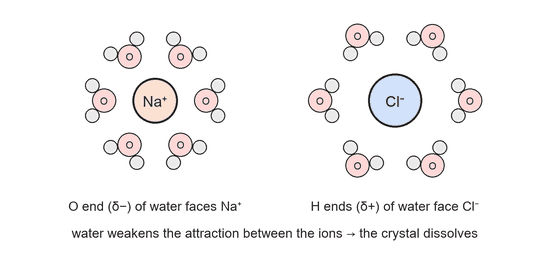
(c) Water is a polar compound. Its δ− oxygen ends attract the cations and its δ+ hydrogen ends attract the anions. This weakens the electrostatic forces between the ions and the ions separate, so the compound dissolves. Most covalent compounds are non-polar and have no ions for water to pull apart, so they do not dissolve (some polar covalent compounds, such as HCl and sugar, are exceptions).
Step 4 — Hard crystals.
(d) The oppositely charged ions are packed in a definite, regular three-dimensional arrangement (the crystal lattice) and held by strong electrostatic forces, so these compounds form hard crystals.
Step 5 — Conductivity of polar covalent compounds.
(e) When a polar covalent compound such as HCl dissolves in water, it ionises, and the ions formed carry the current.
HCl+H2O→H3O++Cl−
Step 6 — Water is polar.
(f) Oxygen (3.5) is much more electronegative than hydrogen (2.1), so the shared pairs in both O–H bonds are pulled towards oxygen: oxygen becomes δ− and the hydrogens δ+. The molecule is bent (its two lone pairs push the bond pairs together), so the partial charges do not cancel. Hence water is a polar covalent molecule.

Watch out: Pure polar covalent compounds (e.g. liquid HCl) do not conduct; they conduct only after ionising in water.
Therefore, each property follows from the particles: free ions explain conduction, strong ionic forces explain high melting points and hard crystals, polar water separates ions, polar covalent compounds conduct after ionising in water, and water is polar because of its bent shape and polar O–H bonds.
