
Question 234 marksEasy
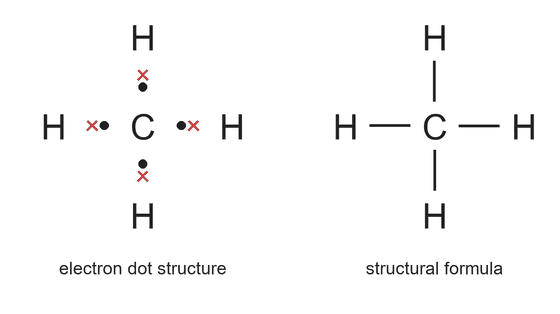
(a) Explain the bonding in methane molecule using electron dot structure. (2015)
(b) Methane molecule is a non-polar molecule. Explain.
Confirming your payment
Sign up now and get 250 free tokens.
Chemical Bonding · Question 23 of 71
(a) Explain the bonding in methane molecule using electron dot structure. (2015)
(b) Methane molecule is a non-polar molecule. Explain.
Solution:
Concept: A covalent bond forms when two atoms (usually of non-metals) share one or more pairs of electrons, each atom putting the same number of electrons into the shared pair(s). Each atom counts the shared electrons in its own outer shell, and so reaches a noble gas configuration. Electronegativity is the tendency of an atom to attract a shared pair of electrons towards itself. If the two bonded atoms have equal electronegativity, the pair is shared equally and the bond is non-polar; if one is more electronegative, it pulls the pair closer, gets a partial negative charge (δ−) and the other a partial positive charge (δ+), and the bond is polar.
Step 1 — See what each atom needs.
Carbon (2, 4) needs 4 more electrons for an octet, and each hydrogen (1) needs 1 more for a duplet. So carbon forms four shared pairs.
Step 2 — Describe the bonding.
(a) Carbon shares each of its four valence electrons with one hydrogen atom, and each hydrogen shares its one electron with carbon. Four shared pairs, i.e. four single covalent bonds, are formed. Carbon gets an octet (like neon) and each hydrogen a duplet (like helium).
Step 3 — Look at each bond.
(b) Carbon (2.5) and hydrogen (2.1) have nearly equal electronegativities (a difference of only 0.4), so each shared pair lies almost midway between C and H.
Step 4 — Look at the shape.
The four C–H bonds are arranged symmetrically around carbon (tetrahedrally), so any small pull in one direction is balanced by the pulls in the other directions. There are no separate δ+ and δ− ends.
Therefore, (a) methane has four single covalent C–H bonds formed by sharing, and (b) it is non-polar because C and H have nearly equal electronegativities and the four bonds are arranged symmetrically.