
Question 222 marksEasy
What do you understand by dipole (polar) molecule ? Explain it by taking hydrogen chloride as an example.
Confirming your payment
Sign up now and get 250 free tokens.
Chemical Bonding · Question 22 of 71
What do you understand by dipole (polar) molecule ? Explain it by taking hydrogen chloride as an example.
Solution:
Concept: Electronegativity is the tendency of an atom to attract a shared pair of electrons towards itself. If the two bonded atoms have equal electronegativity, the pair is shared equally and the bond is non-polar; if one is more electronegative, it pulls the pair closer, gets a partial negative charge (δ−) and the other a partial positive charge (δ+), and the bond is polar.
Step 1 — Define a dipole molecule.
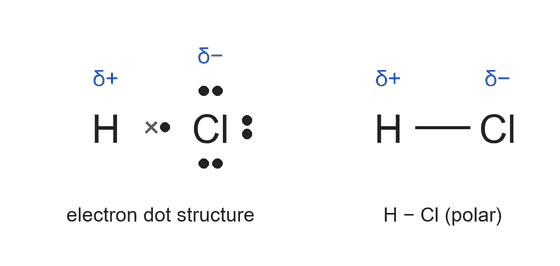
A dipole (polar) molecule is a covalent molecule in which the shared electron pair is displaced towards the more electronegative atom. One end of the molecule carries a partial negative charge (δ−) and the other a partial positive charge (δ+). Since it has two such poles, it is called a dipole.
Step 2 — Look at the bond in HCl.
In hydrogen chloride, hydrogen and chlorine share one electron pair, forming a single covalent bond.
Step 3 — Compare the electronegativities.
Chlorine (electronegativity 3.0) is more electronegative than hydrogen (2.1), so it pulls the shared pair closer to itself. The difference is found as follows.
Step 4 — Mark the charges.
Chlorine becomes δ− and hydrogen δ+, written H(δ+)–Cl(δ−). The molecule has two oppositely charged ends, so it is a dipole.
Watch out: The charges in HCl are only partial (δ), not full charges as in an ionic compound.
Therefore, a dipole (polar) molecule is a covalent molecule with a partial positive end and a partial negative end; in HCl the more electronegative chlorine pulls the shared pair, so it is δ− and hydrogen is δ+.