
Question 552 marksEasy
Electrons are getting added to an element Y.
(a) Is Y getting oxidized or reduced ?
(b) Which electrode will Y migrate to during the process of electrolysis ?
Confirming your payment
Sign up now and get 250 free tokens.
Chemical Bonding · Question 55 of 71
Electrons are getting added to an element Y.
(a) Is Y getting oxidized or reduced ?
(b) Which electrode will Y migrate to during the process of electrolysis ?
Solution:
Concept: Oxidation is the loss of electrons and reduction is the gain of electrons. Electrons lost by one substance are gained by another, so the two always happen together, in a redox reaction. The electron donor is the reducing agent; the electron acceptor is the oxidising agent. An electric current passes through a liquid or a solution only if it contains ions that are free to move. Positive ions (cations) move to the cathode (negative electrode) and negative ions (anions) move to the anode (positive electrode).
Step 1 — Oxidised or reduced.
(a) Gain of electrons is reduction, so Y is getting reduced.
Step 2 — Electrode.
(b) By gaining electrons Y becomes a negative ion (an anion). Unlike charges attract, so during electrolysis the anion migrates to the anode (the positive electrode).
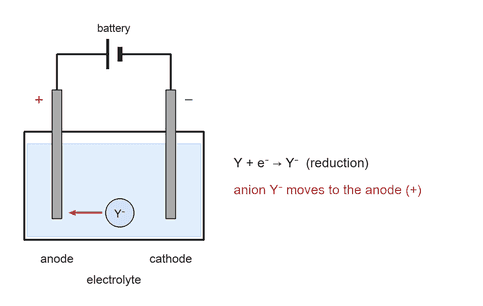
Watch out: The anion goes to the anode; remember 'anion → anode'.
Therefore, (a) Y is reduced, and (b) as an anion, Y migrates to the anode.