Solution:
Concept: Pick a familiar compound that fits each description: what kind of bond it has, and what physical state it is in at room temperature.
Step 1 — Coordinate bond compound.
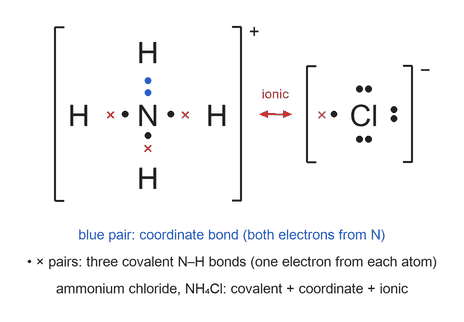
(a) Ammonium chloride (NH₄Cl): its NH₄⁺ ion contains a coordinate bond (the hydronium ion, H₃O⁺, is another example).
NH3+H+→NH4+
Step 2 — Solid covalent compound.
(b) Glucose (C₆H₁₂O₆); urea and naphthalene are other examples.
Step 3 — Gaseous polar covalent compound.
(c) Hydrogen chloride (HCl); ammonia is another example.
Step 4 — Gaseous non-polar covalent compound.
(d) Methane (CH₄).
Step 5 — Liquid non-polar covalent compound.
(e) Carbon tetrachloride (CCl₄).
Step 6 — Electrovalent and covalent bonds.
(f) Sodium hydroxide (NaOH): an ionic bond between Na⁺ and OH⁻, and a covalent O–H bond inside OH⁻ (calcium carbonate is another example).
Step 7 — All three types of bonds.
The second part labelled (f) in the book: ammonium chloride (NH₄Cl), with three covalent N–H bonds, one coordinate bond and an ionic bond between NH₄⁺ and Cl⁻.
Therefore, (a) ammonium chloride, (b) glucose, (c) hydrogen chloride, (d) methane, (e) carbon tetrachloride, (f) sodium hydroxide, and (f, second) ammonium chloride.
