
Question 585 marksEasy
Give reasons :
(a) Hydrogen chloride can be termed as a polar covalent compound.
(b) Covalent compounds can exist as gases, liquids or soft solids.
(c) Carbon tetrachloride does not dissolve in water.
Confirming your payment
Sign up now and get 250 free tokens.
Chemical Bonding · Question 58 of 71
Give reasons :
(a) Hydrogen chloride can be termed as a polar covalent compound.
(b) Covalent compounds can exist as gases, liquids or soft solids.
(c) Carbon tetrachloride does not dissolve in water.
Solution:
Concept: Electronegativity is the tendency of an atom to attract a shared pair of electrons towards itself. If the two bonded atoms have equal electronegativity, the pair is shared equally and the bond is non-polar; if one is more electronegative, it pulls the pair closer, gets a partial negative charge (δ−) and the other a partial positive charge (δ+), and the bond is polar. The state and solubility of a covalent compound depend on the weak forces between its molecules and on whether the molecules are polar.
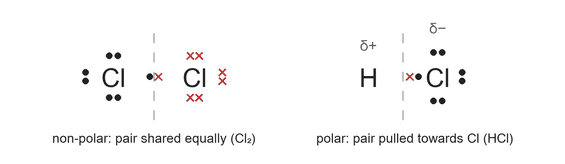
Step 1 — HCl is polar covalent.
(a) In HCl one electron pair is shared between H and Cl, so the compound is covalent. Chlorine (3.0) is more electronegative than hydrogen (2.1), so it pulls the shared pair towards itself: Cl gets a partial negative charge (δ−) and H a partial positive charge (δ+). Hence HCl is a polar covalent compound.
Step 2 — States of covalent compounds.
(b) Covalent compounds consist of molecules, not ions. The forces of attraction between the molecules are weak, so little energy is needed to separate them. Depending on how weak these forces are, the compound is a gas (CH₄), a liquid (CCl₄) or a soft solid (wax) at room temperature.

Step 3 — CCl₄ does not dissolve in water.
(c) CCl₄ is a non-polar covalent compound with no ions. Water is a polar solvent; it dissolves ionic and polar substances by attracting their charged ends. It cannot attract or separate the non-polar CCl₄ molecules, so CCl₄ does not dissolve in water (it dissolves in non-polar organic solvents instead).
Therefore, (a) HCl is polar because Cl pulls the shared pair; (b) weak forces between molecules let covalent compounds be gases, liquids or soft solids; (c) non-polar CCl₄ is not attracted by polar water, so it does not dissolve.