
Question 575 marksEasy
State the type of bonding in the following molecules.
(a) water (b) calcium oxide
(c) hydroxyl ion (d) methane
(e) ammonium ion (f) ammonium chloride
Confirming your payment
Sign up now and get 250 free tokens.
Chemical Bonding · Question 57 of 71
State the type of bonding in the following molecules.
(a) water (b) calcium oxide
(c) hydroxyl ion (d) methane
(e) ammonium ion (f) ammonium chloride
Solution:
Concept: Transfer of electrons gives an electrovalent bond; sharing with one electron from each atom gives a covalent bond; a shared pair that comes from one atom only gives a coordinate bond.
Step 1 — Water.
(a) Two O–H shared pairs, pulled towards the more electronegative oxygen: polar covalent bonds.
Step 2 — Calcium oxide.
(b) Calcium gives 2 electrons to oxygen: electrovalent (ionic) bond.
Step 3 — Hydroxyl ion.
(c) One O–H shared pair, with one extra electron on oxygen giving the charge: covalent bond in OH⁻.
Step 4 — Methane.
(d) Four C–H shared pairs in a symmetrical molecule: covalent (non-polar) bonds.
Step 5 — Ammonium ion.
(e) Three N–H covalent bonds and one N → H bond formed from the lone pair of nitrogen: covalent and coordinate bonds.
Step 6 — Ammonium chloride.
(f) The NH₄⁺ ion as in (e), held to Cl⁻ by an ionic bond: electrovalent, covalent and coordinate bonds.
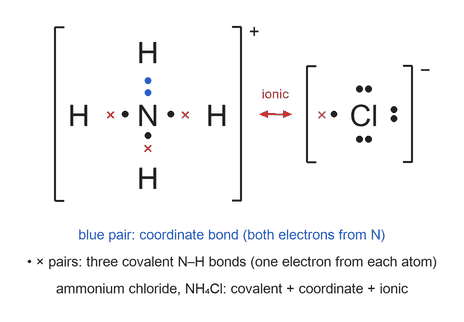
Therefore, (a) covalent (polar), (b) electrovalent, (c) covalent, (d) covalent, (e) covalent and coordinate, (f) electrovalent, covalent and coordinate.