Solution:
Concept: the arrows show blood leaving the ventricles through the two great arteries while the atria fill: that is ventricular systole.
Step 1 — (a) and (b) The phase and the contracting part.
Blood is being pushed out of the ventricles into the pulmonary artery (1) and the aorta (2), so the ventricles are contracting: the phase is ventricular systole (with atrial diastole). The atrio-ventricular valves (5 and 6) are closed, so blood cannot go back into the atria, which are filling from the vena cava and the pulmonary vein.
Step 2 — (c) Name the parts 1–6.
1: pulmonary artery; 2: aorta; 3: pulmonary vein; 4: left atrium; 5: bicuspid (mitral) valve; 6: tricuspid valve.
Step 3 — (d) Blood in 1 and 2.
1 (pulmonary artery) carries deoxygenated blood to the lungs; 2 (aorta) carries oxygenated blood to the body.
Step 4 — (e) Valves closed.
Two valves are closed: the tricuspid and the bicuspid. The two semilunar valves are open.
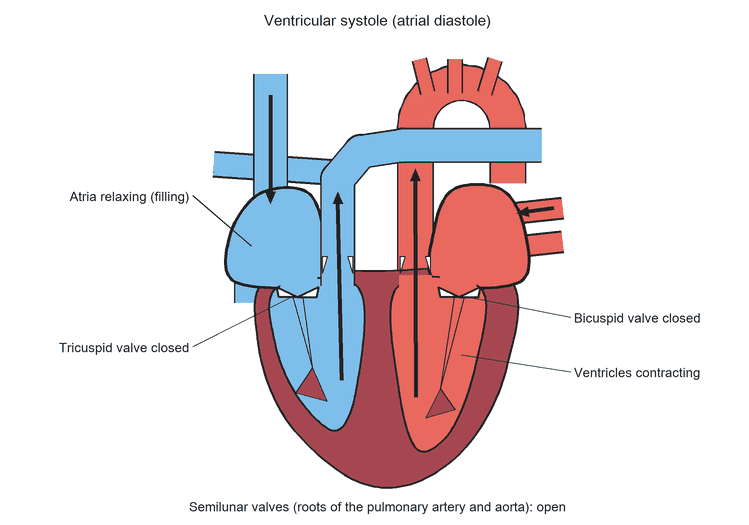
Watch out: In a front view the heart's right side is on the picture's left, so 6 (on the left of the picture) is the tricuspid valve.
Therefore, (a) ventricular systole; (b) the ventricles; (c) 1 pulmonary artery, 2 aorta, 3 pulmonary vein, 4 left atrium, 5 bicuspid valve, 6 tricuspid valve; (d) 1 deoxygenated, 2 oxygenated; (e) two valves.

