Solution:
Concept: a thick wall with a narrow lumen marks an artery, a thin wall with a wide lumen marks a vein, and a tube whose wall is a single layer of cells is a capillary.
Step 1 — (a) Identify A, B and C.
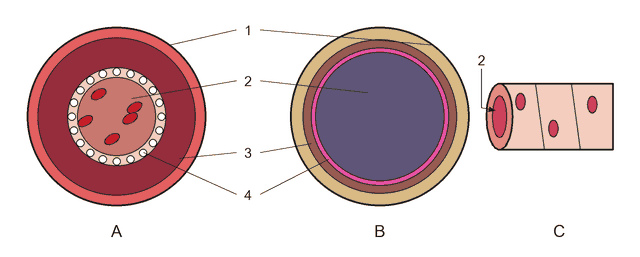
A has a thick wall and a narrow lumen: an artery. B has a thin wall and a wide lumen: a vein. C is a tiny tube only one cell thick, with RBCs passing in single file: a capillary.
Step 2 — (b) Name the parts 1–4.
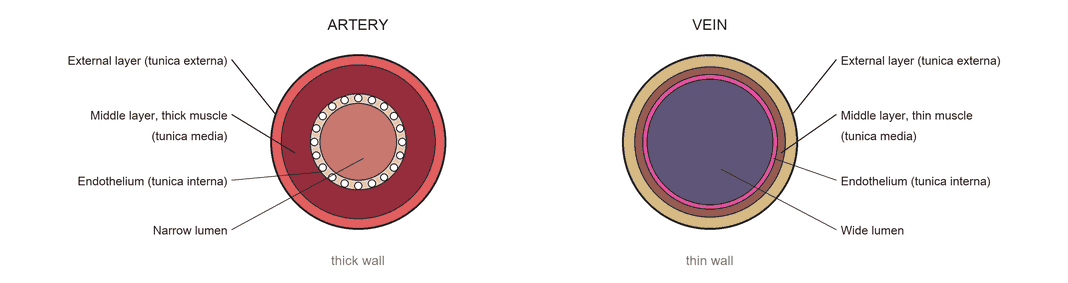
1: outer layer of connective tissue (tunica externa); 2: lumen; 3: middle layer of smooth muscle and elastic fibres (tunica media); 4: endothelium (tunica interna).
Step 3 — (c) Two differences between A and B.
| A (Artery) | B (Vein) |
|---|
| Thick, more muscular, elastic wall | Thin, less muscular wall |
| Narrow lumen | Wider lumen |
| No valves | Has valves |
Step 4 — (d) and (e) Blood carried, and where gases are exchanged.
A carries oxygenated blood (except the pulmonary artery); B carries deoxygenated blood (except the pulmonary vein). Gases are exchanged in C, the capillary: its wall is one cell thick with no muscle, so oxygen diffuses out to the tissues and carbon dioxide diffuses in.

Therefore, (a) A artery, B vein, C capillary; (b) 1 tunica externa, 2 lumen, 3 tunica media, 4 endothelium; (c) thick wall and narrow lumen in A, thin wall and wide lumen in B; (d) A oxygenated, B deoxygenated; (e) C, the capillary.