Solution:
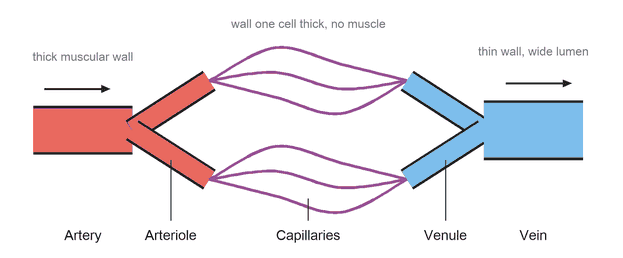
Concept: the structure of each kind of blood vessel suits its work: arteries carry blood away from the heart, capillaries exchange substances with the tissues, and veins bring blood back.
Step 1 — (i) Veins.
Veins carry blood at low pressure, so their walls are thin. Pocket-shaped valves open towards the heart and stop the blood slipping back. So: the veins have thin and less muscular walls, and have valves to prevent back flow of blood.

Step 2 — (ii) Arteries.
An artery reaching an organ branches into smaller and smaller vessels; its smallest branches are arterioles, which end in capillaries. So: arteries carry blood to an organ and break up into arterioles ending in capillaries.
Step 3 — (iii) Capillary wall.
A capillary wall is only one layer of flat cells, the endothelium, with no muscle. So: walls of capillaries consist of a single layer of squamous epithelial cells.
Step 4 — (iv) Where exchange happens.
Because the capillary wall is only one cell thick, oxygen, carbon dioxide, glucose, amino acids, urea and hormones pass through it easily. So: substances diffuse through the walls of capillaries.
Therefore, (i) veins, walls, valves, blood; (ii) arteries, arterioles; (iii) epithelial; (iv) capillaries.
