Solution:
Concept: The membranous labyrinth has three parts: the semicircular canals, the vestibule (utriculus and sacculus) and the cochlea.
Step 1 — (a) Draw the labyrinth.
Draw three canals, each with a swollen ampulla at one end, joined to the vestibule (utriculus and sacculus), and a cochlea coiled like a snail shell with about two and a half turns; then label it:
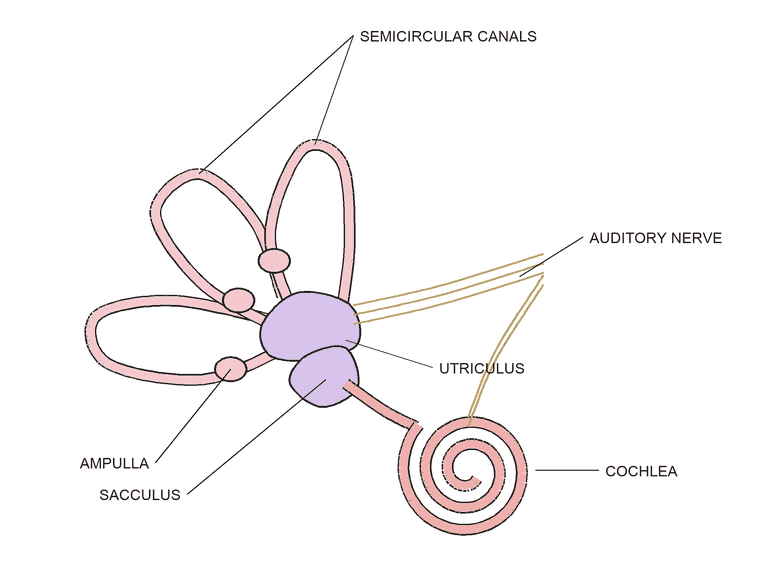
Labels: semicircular canals, ampulla, utriculus, sacculus, cochlea, auditory nerve.
Step 2 — (b)(i) Structure for hearing.
The cochlea.
Step 3 — (b)(ii) Sensory cells for hearing.
The sensory hair cells of the organ of Corti, lying on the basilar membrane in the median canal of the cochlea.
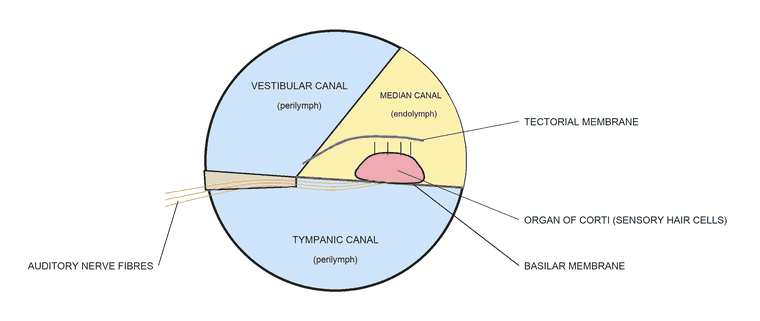
Step 4 — (b)(iii) Opening from the middle to the inner ear.
The membrane-covered oval window, on which the stapes fits.
Step 5 — (b)(iv) Nerve from the ear to the brain.
The auditory nerve.
Step 6 — (b)(v) Tube equalising the pressure.
The Eustachian tube, which joins the middle-ear cavity to the throat.
Watch out: The question says "drawn above in (i)"; it means part (a).
Therefore, (a) as drawn in Step 1; (b) cochlea, organ of Corti hair cells, oval window, auditory nerve, Eustachian tube.
