Solution:
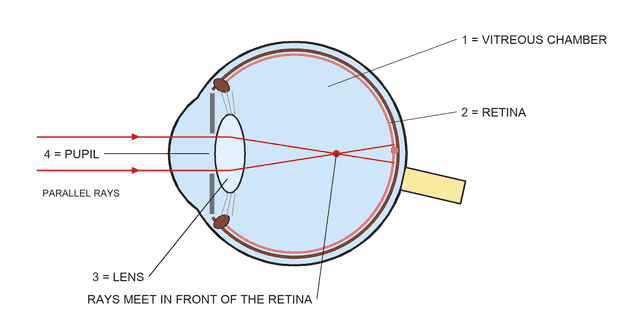
Concept: Parallel rays from a distant object meet in front of the retina, which is short-sightedness (myopia).
Step 1 — (a) Name the defect.
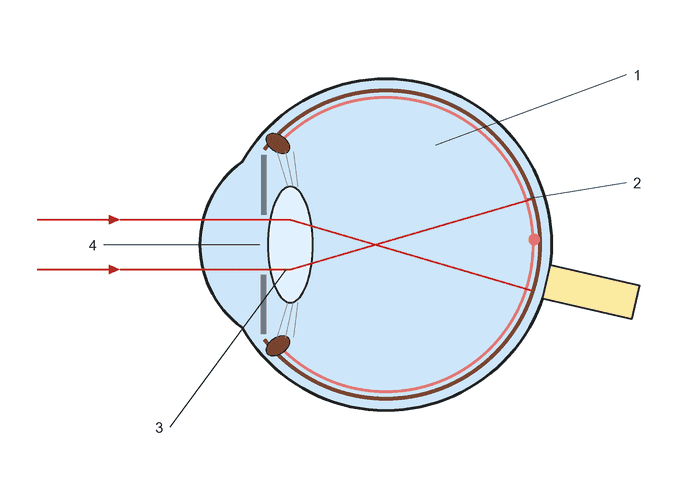
The rays meet before the retina, so the defect is myopia (short-sightedness): near objects are clear, distant ones blurred.
Step 2 — (b) Two possible reasons.
(1) The eyeball is lengthened from front to back; (2) the lens is too curved (too convex). Both make the rays meet too early.
Step 3 — (c) Name the parts 1 to 4.
1 – Vitreous chamber (vitreous humour); 2 – Retina; 3 – Lens; 4 – Pupil.
Step 4 — (d) Correcting lens.
A concave (diverging) lens; the power of such glasses is written with a minus sign.
Step 5 — (e) Diagram of the correction.
The concave lens spreads the rays slightly before they enter the eye, so the eye lens now brings them to a focus on the retina.

Labels: concave lens, eye lens, retina, image on retina.
Watch out: Myopia is corrected by a concave lens; a convex lens would make it worse.
Therefore, (a) myopia; (b) elongated eyeball or over-curved lens; (c) 1 vitreous chamber, 2 retina, 3 lens, 4 pupil; (d) concave lens; (e) as drawn in Step 5.