Solution:
Concept: Each fact follows from a point of structure: the tear drainage to the nose, the lever chain of ossicles, and the absence of sensory cells at the blind spot.
Step 1 — (a) Why eye drops reach the nose and throat.
Fluid on the eye drains through the tear ducts into a sac at the inner corner, and the nasolacrimal duct carries it into the nasal cavity; from there it can pass into the throat, where the medicine is tasted.

Step 2 — (b) Why three ossicles are better than one bone.
The three ossicles are jointed in a chain that works as a system of levers. This amplifies the vibrations of the ear drum before they reach the oval window, so faint sounds can be heard; a single rigid bone could not amplify them in this way.
Step 3 — (c) Why the blind spot gives no vision.
At the blind spot the nerve fibres from the whole retina gather and leave as the optic nerve, and no rods or cones are present. So light falling there produces no impulse and no image.
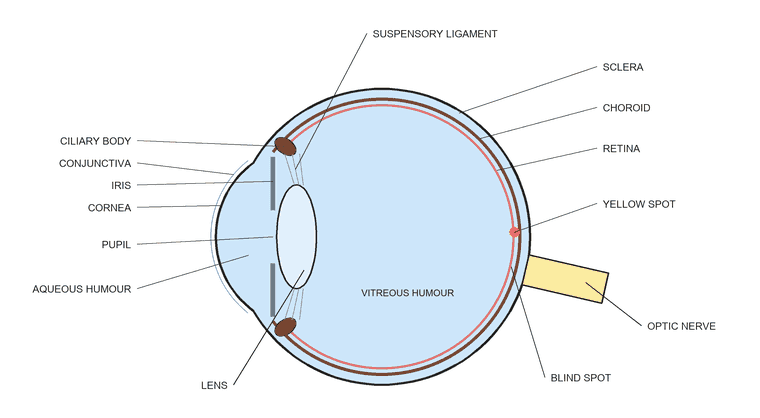
Therefore, (a) the nasolacrimal duct carries eye fluid into the nose; (b) the ossicle chain amplifies vibrations; (c) the blind spot has no rods or cones.
