Solution:
Concept: Compare each pair only on the basis given in brackets.
Step 1 — Set out the differences.
Each row compares the two members of one pair:
| Pair | First member | Second member |
|---|
| (a) Lens for correction | Myopia: concave (diverging) lens | Hyperopia: convex (converging) lens |
| (b) Sensitivity | Rods: dim light; no colour | Cones: bright light and colour |
| (c) Location | Aqueous humour: in front of the lens (cornea to lens) | Vitreous humour: behind the lens (lens to retina) |
| (d) Shape of lens | Near: lens thicker, more convex | Distant: lens thinner, flatter |
| (e) Pigment regenerated | Dark adaptation: rhodopsin (visual purple) | Light adaptation: iodopsin (visual violet) |
| (f) Cells affected | Night blindness: rods | Colour blindness: cones |
Step 2 — Explain (a).
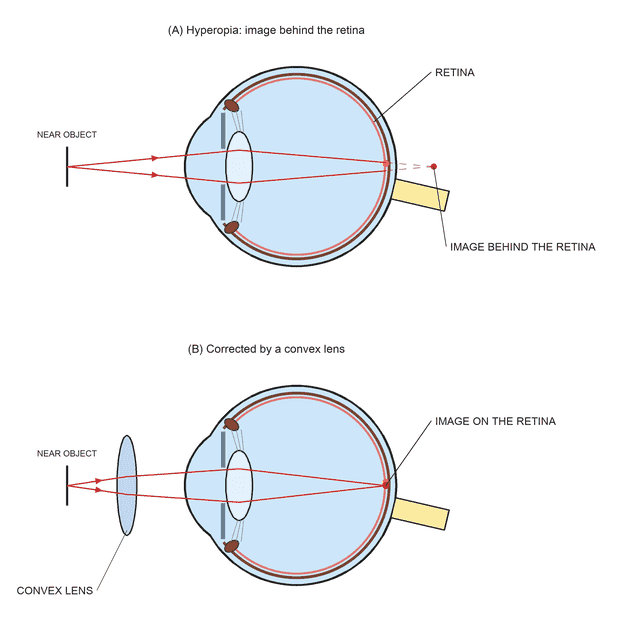
In myopia the image of a distant object forms in front of the retina, so the rays must be spread out first by a concave lens; in hyperopia the image of a near object falls behind the retina, so the rays must be brought together by a convex lens.

Step 3 — Explain (d).
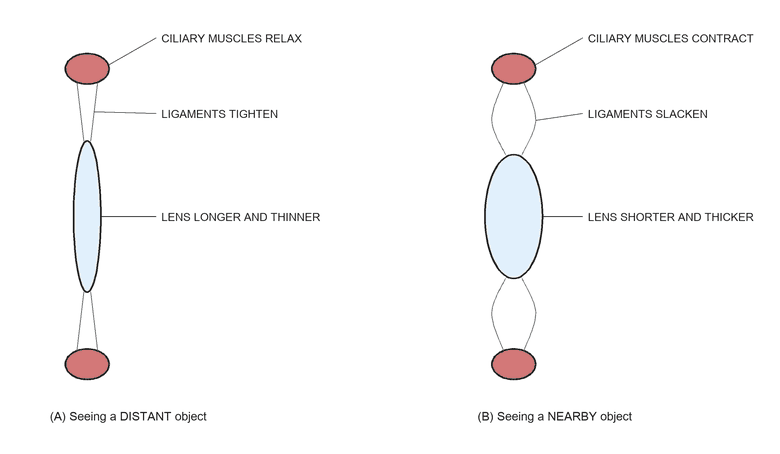
For a near object the ciliary muscles contract and the ligaments slacken, so the elastic lens becomes thicker; for a distant object the muscles relax and the tight ligaments pull the lens thin.
Step 4 — Explain (f).
Only rods work in dim light, so night blindness is a failure of the rods; colour is seen only by cones, so colour blindness is a defect of the cones.
Watch out: In (e) the pigment regenerated in dark adaptation is rhodopsin (rods take over); in light adaptation it is iodopsin (cones take over).
Therefore, the six differences are as tabulated in Step 1.
