Answer: (C) (3) Both A and R are True
Concept: In an assertion–reason item, judge the Assertion (A) and the Reason (R) separately as true or false. Here the four choices only ask whether each statement is true, so we do not have to decide whether R explains A. Here, the inner ear has three parts, and each part has its own job.
Step 1 — Judge the Assertion (A).
True. The ear serves hearing and both kinds of balance, dynamic and static.
Step 2 — Judge the Reason (R).
True. The cochlea serves hearing, the semi-circular canals dynamic balance (body in motion), and the vestibule (utriculus and sacculus) static balance (body at rest).
Step 3 — Does R explain A?
R names the part that does each of the three jobs in A, so it also explains A; option (3) needs only that both are true.
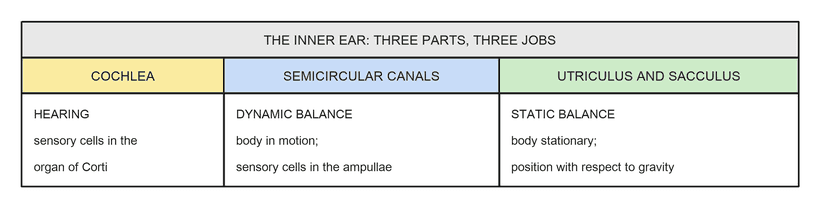
Watch out: "respectively" pairs the parts and jobs in order; check each pair before calling R true.
Why the other options are wrong:
- (A) (1) A is True and R is False: It calls the Reason false, but the Reason is true.
- (B) (2) A is False and R is True: It calls the Assertion false, but the Assertion is true.
- (D) (4) Both A and R are False: It calls the Assertion false, but the Assertion is true; and it calls the Reason false, but the Reason is true.
Therefore, both A and R are true, option (C).
