Solution:
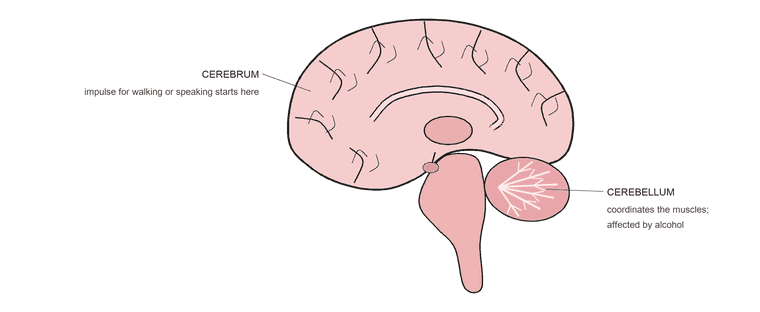
Concept: The impulse for a muscular act starts in the cerebrum, but the cerebellum coordinates the muscles that carry it out. Alcohol upsets the working of the cerebellum.
Step 1 — (a) Effect of alcohol and the part affected.
Alcohol affects the cerebellum, which then cannot coordinate the muscles properly. So a drunk person walks clumsily and his speech is slurred, because both walking and speaking need many muscles timed together.
Step 2 — (b) Where the impulse for walking or speaking arises.
The impulse for any muscular act, such as walking or speaking, starts in the cerebrum.
Step 3 — (c) Structural differences between the two parts.
Compare their size, position and surface:
| Cerebellum (part (a)) | Cerebrum (part (b)) |
|---|
| A much smaller part, at the base of and under the cerebrum. | The largest part of the brain, divided into two cerebral hemispheres. |
| Surface has no convolutions, only fine parallel furrows. | Surface is highly convoluted, with ridges (gyri) and grooves (sulci). |
| Its white matter looks like a branching tree in a median section. | Its white matter shows no such tree-like pattern. |
Watch out: The cerebrum starts a movement; the cerebellum coordinates it. Alcohol affects the coordinating part.
Therefore, (a) alcohol affects the cerebellum, so movements and speech are uncoordinated; (b) the cerebrum; (c) the cerebellum is smaller, unconvoluted and tree-like inside, the cerebrum largest and convoluted.
