Solution:
Concept: The figure shows a neuron, with a cell body, dendrites and a long myelinated axon. It is the structural and functional unit of the nervous system.
Step 1 — (a) Technical term.
A cell with a cell body, dendrites and a long axon is a neuron (nerve cell).
Step 2 — (b) Organs rich in neurons.
The brain and the spinal cord are made up of neurons.
Step 3 — (c) Why neurons matter.
Neurons receive stimuli and carry impulses between the sense organs, the brain and spinal cord, and the muscles and glands. In this way they control and coordinate all the activities of the body, and they let us remember, think and reason.
Step 4 — (d) The missing organelle and its effect.
The centrosome is absent, and mature nerve cells cannot divide. So a damaged or dead neuron is not replaced, and the work it did may be lost for good; this is why injuries to the brain or spinal cord heal so poorly.
Step 5 — (e) Redraw and label.
Redraw the neuron and label the five parts asked for:
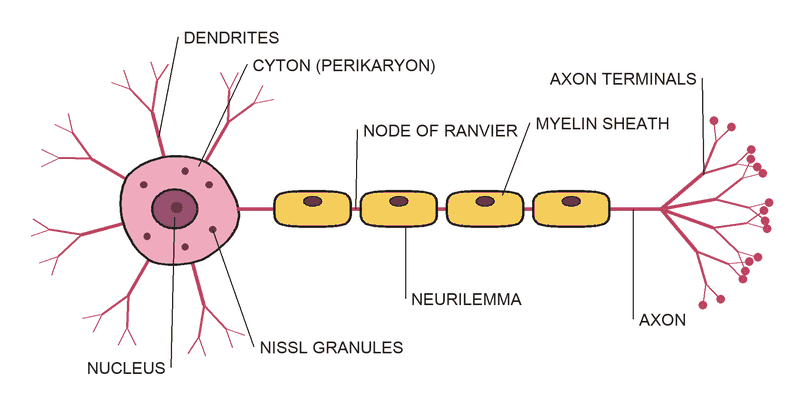
Labels: perikaryon (cyton), axon, dendrites, myelin sheath, node of Ranvier.
Watch out: Nerve cells lack the centrosome, not the nucleus; they have a well-defined nucleus.
Therefore, (a) neuron; (b) brain and spinal cord; (c) they carry impulses that control and coordinate the body; (d) the centrosome, so lost neurons are not replaced; (e) as drawn in Step 5.

