Solution:
Concept: Compare each pair only on the basis given in brackets, setting the two points side by side.
Step 1 — (a) Cerebrum and cerebellum (function).
Their roles differ: one thinks and starts actions, the other balances and coordinates.
| Cerebrum | Cerebellum |
|---|
| Seat of intelligence, memory, consciousness and will power; controls voluntary actions. | Maintains the balance of the body and coordinates muscular activity. |
Step 2 — (b) Sympathetic and parasympathetic systems (location and role).
The two parts of the autonomic system lie in different places and act in opposite ways.
| Sympathetic nervous system | Parasympathetic nervous system |
|---|
| Its nerves arise from the spinal cord between the neck and the waist. | Located at two places: in the head and neck, and in the sacral region. |
| Prepares the body for violent action against abnormal conditions, e.g. speeds up the heart beat. | Restores normal conditions after the violent act, e.g. slows down the heart beat. |
Step 3 — (c) Sensory and motor nerve (direction of impulse).
They carry impulses in opposite directions.
| Sensory nerve | Motor nerve |
|---|
| Carries impulses from the receptors (sense organs) to the brain or spinal cord, e.g. the optic nerve. | Carries impulses from the brain or spinal cord to the effectors (muscles or glands), e.g. the nerves to the eyeball muscles. |
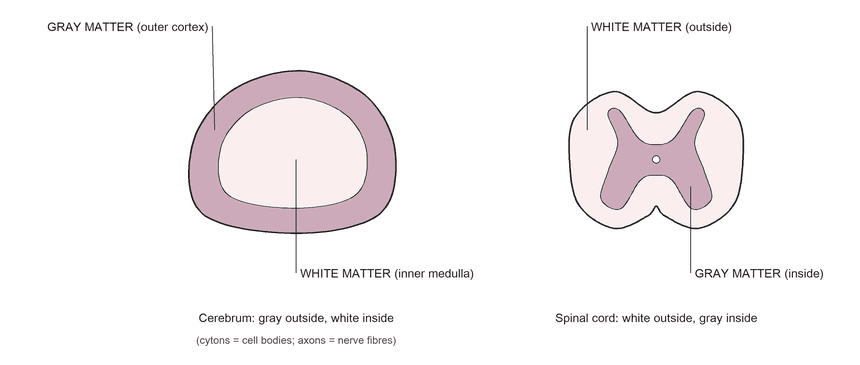
Step 4 — (d) Cerebrum and spinal cord (arrangement of cytons and axons).
The arrangement in the spinal cord is the reverse of that in the cerebrum.
| Cerebrum | Spinal cord |
|---|
| Cytons in the outer part (gray matter, cortex); axons in the inner part (white matter). | Cytons in the inner part (gray matter); axons in the outer part (white matter). |
Step 5 — (e) Cranial and spinal nerves (number in pairs).
They are counted in pairs because each nerve has a partner on the other side.
| Cranial nerves | Spinal nerves |
|---|
| 12 pairs, arising from the brain. | 31 pairs, arising from the spinal cord. |
Step 6 — (f) Nerve impulse and flow of electricity (transmission and speed).
A nerve impulse is not a current flowing along the fibre, and it is far slower.
| Nerve impulse | Flow of electricity |
|---|
| A wave of depolarisation followed by repolarisation passing along the fibre; ions only move in and out across the membrane at each spot, nothing flows along the fibre. | Electrons move along the wire as a current. |
| Slow: at most about 100 metres per second. | Very fast: the signal travels along a wire at nearly the speed of light (lakhs of kilometres per second). |
Step 7 — (g) Medulla oblongata and cerebellum (function).
One runs the internal organs, the other the balance of the body.
| Medulla oblongata | Cerebellum |
|---|
| Controls the internal organs and other involuntary actions, e.g. heart beat, breathing, peristalsis. | Maintains the balance of the body and coordinates muscular activity. |
Watch out: Answer each pair only on its bracketed basis; for example, in (d) talk about where cytons and axons lie, not about functions.
Note: in (f) an electrical signal travels along a wire at nearly the speed of light (about 2 to 3 lakh km per second), so no single exact figure is given for it here.
Therefore, the seven differences are as tabulated in Steps 1 to 7.
