
Question 3412 marksEasy
Define the following terms :
(a) Neuron
(b) Nerve
(c) Stimulus
(d) Synaptic cleft
(e) Reflex action
(f) Corpus callosum
Confirming your payment
Sign up now and get 250 free tokens.
The Nervous System · Question 34 of 46
Define the following terms :
(a) Neuron
(b) Nerve
(c) Stimulus
(d) Synaptic cleft
(e) Reflex action
(f) Corpus callosum
Solution:
Concept: A definition states exactly what the term is in one or two lines; a short explanation follows each.
Step 1 — (a) Neuron.
A neuron (nerve cell) is the structural and functional unit of the nervous system. It has a cell body, dendrites and an axon, and it conducts nerve impulses.
Step 2 — (b) Nerve.
A nerve is a bundle of nerve fibres (axons) of separate neurons enclosed in a tubular sheath, like a cable holding many insulated wires.
Step 3 — (c) Stimulus.
A stimulus is an agent or a sudden change in the external or internal environment that causes a change in an organism or in any of its parts; for example light, sound, heat, pain or hunger.
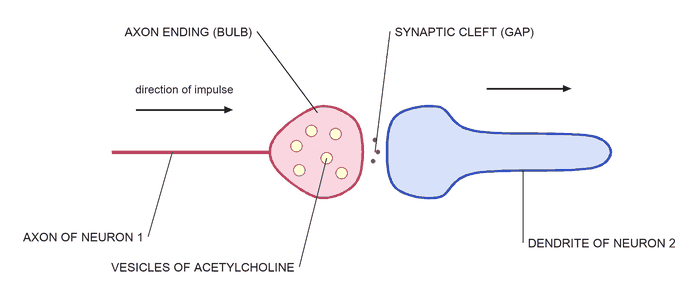
Step 4 — (d) Synaptic cleft.
The synaptic cleft is the fine gap between the axon endings of one neuron and the dendrites of the next at a synapse. The two neurons come close here but do not touch; a chemical carries the impulse across.
Step 5 — (e) Reflex action.
A reflex action is an automatic, quick, involuntary action in the body brought about by a stimulus; for example, pulling the hand away at once from a hot iron.
Step 6 — (f) Corpus callosum.
The corpus callosum is a sheet of nerve fibres joining the two cerebral hemispheres; it transfers information from one hemisphere to the other.
Watch out: A nerve is a bundle of many axons; a neuron is one cell. A synapse is the junction; the synaptic cleft is the gap within it.
Therefore, the six definitions are the bold statements in Steps 1 to 6.