
Question 264 marksHard
A horizontal metal rod of mass can slide without friction down two long vertical conducting rails apart. The rails are joined at the top through a resistor . A uniform horizontal magnetic field of acts perpendicular to the plane of the rails, into the page, as shown. The rod is released from rest. Neglect the resistance of the rod and rails. (Hypothetical data.)
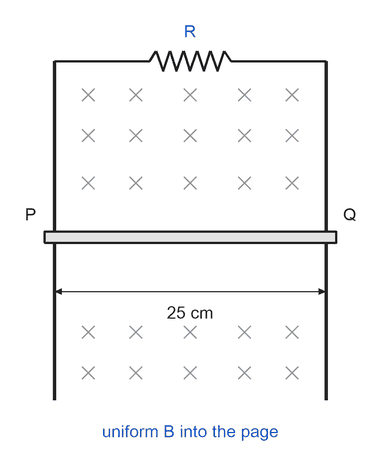
(i) State the direction of the induced current in the rod.
(ii) Explain why the rod reaches a constant (terminal) speed, and find this speed.
(iii) Find the current at terminal speed, and show that the rate of loss of gravitational potential energy then equals the rate of heating in .
(Take .)