
Opening your dashboard
Class 12 Physics Chapter 11 Electromagnetic Induction: Competency-Based Questions (CBQ)
47 questions on Chapter 11, each worked through on its own page with the AI tutor. Class 12 Physics, ICSE 2026-27.
47 questions
1–4 marks · Mixed difficulty
- 13 marks
Question 1
Competency: Application
An engineer makes a tilt sensor for a platform. A flat coil of turns, each of area , is fixed to the platform. It sits in the uniform field of an electromagnet. When the platform is level, the plane of the coil is at right angles to the field. When the platform tilts by an angle , the normal to the coil turns through the same angle away from the field. A meter reads the flux linkage of the coil. (Hypothetical data.)
(a) Find the flux linkage when the platform is level.
(b) The meter reads . Find the tilt angle.
(c) Find the change in flux linkage when the tilt goes from to , and when it goes from to . What do your answers tell you about this sensor for very small tilts?
- 21 mark
Question 2
Competency: Analysis & Evaluation
A rectangular wire loop lies flat on a table. A long, straight, insulated wire lies on top of the loop, in its plane, running exactly along the line that divides the loop into two equal halves. The long wire carries a steady current.
Assertion (A): The net magnetic flux through the loop is zero, although the magnetic field at every point of the loop's area is non-zero.
Reason (R): The field of the wire passes upward through the loop on one side of the wire and downward on the other side, with equal strength at equal distances from the wire.
- 31 mark
Question 3
Competency: Application
Near the edge of a magnet's pole piece, a student finds that the field is at right angles to a square sensing loop of side , but not uniform. It rises steadily (linearly) from along one edge of the loop to along the opposite edge, and is the same all along any line parallel to those edges. (Hypothetical data.) The magnetic flux through the loop is
- 44 marks
Question 4
Competency: Analysis & Evaluation
A small bar magnet is dropped, north pole first, through a vertical coil of turns connected to a data logger. The logger shows two pulses of emf. The first, while the magnet enters the coil, is positive with a peak of and lasts . The second, while it leaves, is negative with a peak of . Treat each pulse as a triangle. (Hypothetical data.)
(a) Why are the two pulses of opposite sign?
(b) Use the first pulse to find the change in magnetic flux through each turn as the magnet enters the coil.
(c) The flux through each turn changes by the same amount as the magnet leaves. Find how long the second pulse lasts, and explain why it is taller and shorter than the first.
- 51 mark
Question 5
Competency: Analysis & Evaluation
In one trial the flux through a coil rises steadily from to in . In a second trial it falls steadily from to in .
Assertion (A): The average induced emf has the same size in both trials.
Reason (R): The direction of the induced emf is the same whether the flux increases or decreases.
- 61 mark
Question 6
Competency: Analysis & Evaluation
A card reader has a small coil (the read head). As the card's magnetic stripe is swiped past it, the magnetised regions on the stripe change the flux through the coil and produce a series of emf pulses. A customer swipes the same card twice as fast. Compared with the slow swipe, each pulse
- 73 marks
Question 7
Competency: Application
Lightning strikes a tall tree from a house. The current in the vertical lightning channel rises from zero to in . Inside the house, a badly laid electric circuit forms a loop of area in a vertical plane that passes through the lightning channel. Treat the channel as a long straight wire and the field over the loop as uniform. (Hypothetical data.) (Take .)
(a) Find the magnetic field at the house when the current is at its peak.
(b) Find the average emf induced in the loop while the current rises.
(c) Electricians run the two wires of a circuit side by side. If this reduces the loop area to , what is the induced emf now?
- 84 marks
Question 8
Competency: Application
The wheel-speed sensor of a car has a coil wound round a small bar magnet whose north pole faces a toothed steel ring fixed to the wheel. When a tooth comes in front of the magnet, more of the magnet's field lines pass through the coil; when a gap comes in front, fewer do. The ring has teeth and the wheel has a radius of . (Hypothetical data.)
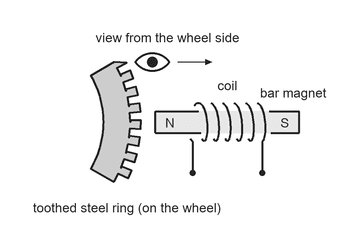
(a) As a tooth approaches the magnet, what is the sense of the induced current in the coil, as seen from the wheel side? Which pole does the coil's end facing the wheel become?
(b) What happens to the induced current as that tooth moves away?
(c) The emf of the sensor is found to have a frequency of . Find the number of revolutions per second of the wheel and the speed of the car in .
- 91 mark
Question 9
Competency: Analysis & Evaluation
A student pushes the same bar magnet, at the same steady speed, towards two identical copper coils. The ends of coil 1 are joined by a thick wire; the ends of coil 2 are left free.
Assertion (A): The student has to do more work in pushing the magnet towards coil 1 than towards coil 2.
Reason (R): No emf is induced in a coil whose ends are not joined.
- 101 mark
Question 10
Competency: Analysis & Evaluation
In a "can crusher" demonstration, an empty aluminium can is placed inside a short coil, coaxial with it. A very large current pulse, rising in a few microseconds, is sent through the coil. The can is found crushed. Which is the correct explanation?
- 113 marks
Question 11
Competency: Application
An electromagnetic flowmeter on a water main has a pipe of internal diameter . Coils outside the pipe set up a uniform magnetic field of across it, at right angles to the flow. Two electrodes are fixed on the inner wall at the ends of a diameter that is at right angles to both the field and the flow. A voltmeter between them reads . Take the water speed to be the same across the pipe. (Hypothetical data.)
(a) Find the speed of the water.
(b) Find the volume of water flowing per minute, in litres.
(c) Why cannot this meter be used to measure the flow of petrol in a pipe?
- 121 mark
Question 12
Competency: Analysis & Evaluation
A metal rod slides along its own length through a region where a uniform magnetic field is at right angles to the rod.
Assertion (A): An emf is induced between the ends of the rod.
Reason (R): A charge moving at right angles to a magnetic field experiences a magnetic force of magnitude .
- 131 mark
Question 13
Competency: Application
A satellite orbits near the magnetic equator, moving due east at . It trails a straight conducting tether long that hangs vertically. There the Earth's magnetic field is horizontal, pointing north, of strength . (Hypothetical data.) The emf between the ends of the tether is about
- 144 marks
Question 14
Competency: Analysis & Evaluation
Students use an "earth inductor" to find the Earth's magnetic field. It is a coil of turns, each of area , that can be spun at about an axis in its plane. With the axis vertical, the peak emf is . With the axis horizontal, along the magnetic north–south line, the peak emf is . (Hypothetical data.)
(a) Which component of the Earth's field produces the emf in each case? Give a reason.
(b) Find the angle of dip at the place.
(c) Find the horizontal component of the Earth's field.
(d) Find the total Earth's field at the place.
- 151 mark
Question 15
Competency: Analysis & Evaluation
A data logger records the emf of a coil spinning at a steady rate in a uniform magnetic field and then works out the average emf over exactly one revolution.
Assertion (A): The average induced emf over one complete revolution is zero.
Reason (R): The flux linked with the coil at the end of a complete revolution is the same as at its start.
- 161 mark
Question 16
Competency: Analysis & Evaluation
A student turns the handle of a small hand-cranked generator. With nothing connected to its terminals the handle turns easily. With a bulb connected it is harder to turn, and with the terminals joined by a thick copper wire it is harder still. Which is the best explanation?
- 171 mark
Question 17
Competency: Analysis & Evaluation
A strong, small magnet is dropped down a long vertical copper pipe. It takes much longer to come out at the bottom than an unmagnetised piece of the same size and mass.
Assertion (A): After a short distance the magnet falls down the pipe at a steady speed.
Reason (R): Copper is not attracted by a magnet.
- 181 mark
Question 18
Competency: Application
At a recycling plant, crushed waste on a conveyor belt passes over a drum in which strong magnets spin very fast. Aluminium cans are flung forward off the belt, while pieces of plastic, glass and paper simply drop off the end. Iron pieces have already been removed. Why are the aluminium cans thrown off?
- 193 marks
Question 19
Competency: Analysis & Evaluation
In an older type of car speedometer, a permanent magnet is spun by a cable driven by the wheels. Close to it, but not touching, is a light aluminium cup mounted on a spindle that carries the pointer. A hairspring holds the cup back. The turning effect of the magnet on the cup is proportional to the speed of the magnet, and the hairspring's turning effect is proportional to the angle through which the cup turns. At the pointer is turned through . (Hypothetical data.)
(a) Why does the cup try to turn in the same direction as the magnet?
(b) Why does the pointer settle at a steady angle instead of spinning, and what angle shows ?
(c) Why is the cup made of aluminium and not of steel?
- 203 marks
Question 20
Competency: Application
The main coil of a hospital MRI scanner is a superconducting solenoid (zero resistance) of self-inductance . In normal use it carries a steady current of . (Hypothetical data.)
(a) Find the energy stored in the coil.
(b) The power supply used to bring the current up to can give at most . Find the least time needed to raise the current from zero.
(c) In an emergency the current is brought down steadily to zero in . Find the self-induced emf during this time, and state what it tries to do.
- 211 mark
Question 21
Competency: Analysis & Evaluation
A student measures the flux linked with an air-cored solenoid at two different steady currents.
Assertion (A): The self-inductance of an air-cored solenoid doubles when the current through it is doubled.
Reason (R): The magnetic flux linked with the solenoid is directly proportional to the current through it.
- 221 mark
Question 22
Competency: Application
A laboratory electromagnet has a uniform field of in its air gap. The gap is in area and wide. (Hypothetical data.) (Take .) The magnetic energy stored in the gap is about
- 234 marks
Question 23
Competency: Application
The ignition coil of a petrol engine has a primary coil of self-inductance and a secondary coil of self-inductance , wound on the same iron core. The coefficient of coupling between them is . A current of in the primary is switched off and falls to zero in . (Hypothetical data.)
(a) Find the mutual inductance of the two coils.
(b) Find the average emf induced in the secondary while the primary current falls.
(c) Find the energy stored in the primary just before it is switched off.
(d) When the primary is switched on, its current takes about to rise to . Find the average secondary emf now, and explain why the spark (which needs about ) occurs only at switch-off.
- 241 mark
Question 24
Competency: Analysis & Evaluation
Two flat circular coils have the same centre, but the plane of one is at right angles to the plane of the other, like two rings of a gyroscope frame.

Assertion (A): The mutual inductance of this pair of coils is zero.
Reason (R): The mutual inductance of two coils depends on the number of turns in each coil.
- 251 mark
Question 25
Competency: Application
A school hall has a hearing loop: a single loop of wire laid round the edge of the floor carries a current that varies with the sound from the stage microphone. A listener's hearing aid contains a tiny coil (a telecoil) in which an emf is induced by mutual induction with the loop. The listener sits near the middle of the hall. For the strongest signal, the axis of the telecoil should be
- 264 marks
Question 26
A horizontal metal rod of mass can slide without friction down two long vertical conducting rails apart. The rails are joined at the top through a resistor . A uniform horizontal magnetic field of acts perpendicular to the plane of the rails, into the page, as shown. The rod is released from rest. Neglect the resistance of the rod and rails. (Hypothetical data.)
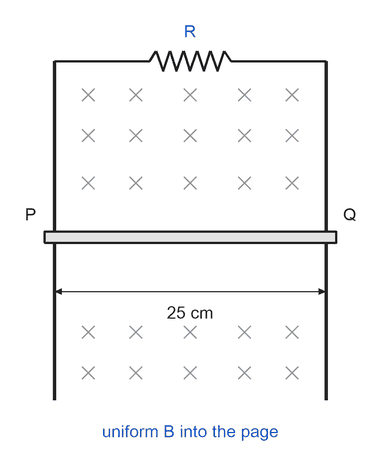
(i) State the direction of the induced current in the rod.
(ii) Explain why the rod reaches a constant (terminal) speed, and find this speed.
(iii) Find the current at terminal speed, and show that the rate of loss of gravitational potential energy then equals the rate of heating in .
(Take .)
- 273 marks
Question 27
A long straight wire carries a steady current of . A metal rod is held perpendicular to the wire, in the same plane, with its near end at and its far end at from the wire. The rod moves with a steady velocity of parallel to the wire, in the direction of the current, as shown.
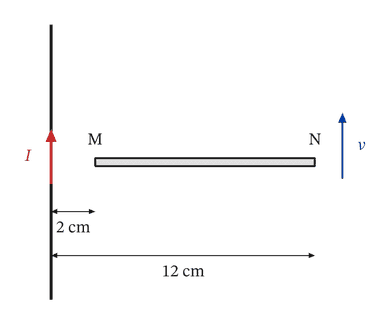
(i) Explain why cannot be used directly for the whole rod.
(ii) Find the emf induced between the ends of the rod.
(iii) Which end of the rod is at the higher potential?
(Take .)
- 283 marks
Question 28
The magnetic flux through a coil perpendicular to its plane is varying according to the relation Wb. Calculate the induced current through the coil at s if the resistance of the coil is .
- 293 marks
Question 29
A circular copper disc cm in radius rotates at about an axis through its centre and perpendicular to the disc. A uniform magnetic field of T acts perpendicular to the disc.
(i) Calculate the potential difference developed between the axis of the disc and the rim.
(ii) What is the induced current, if the resistance of the disc is ?
- 303 marks
Question 30
The self-inductance of an inductance coil having turns is mH. Calculate the magnetic flux through the cross-section of the coil corresponding to a current of mA. Also find the total flux.
- 313 marks
Question 31
A solenoidal coil has turns per centimetre along its length and a cross-sectional area of . turns of another wire is wound round the first solenoid coaxially. The two coils are electrically insulated from each other. Calculate the mutual inductance between the two coils.
- 323 marks
Question 32
A square copper coil of each side cm consists of turns. The coil is initially in vertical plane, such that the plane of the coil is normal to uniform magnetic field of induction . The coil is turned through about a horizontal axis in s. Find the induced e.m.f.
- 333 marks
Question 33
A circular loop of diameter cm is kept perpendicular to a uniform magnetic field of T. If the loop is removed from the field, in a direction perpendicular to the field in s, calculate the average e.m.f. induced in the loop.
- 343 marks
Question 34
A closed coil of diameter m and ohm resistance having turns is placed normally to a field of T. The coil is rotated through in s. Calculate the induced e.m.f. and the current.
- 353 marks
Question 35
How many turns should a solenoid have in order that its self-inductance is H, if it is cm long? The area of cross-section of the solenoid is and half of its core is air and the other half is iron of relative permeability .
- 363 marks
Question 36
The mean diameter of a toroidal coil having turns is cm and has a cross sectional area of . Find the inductance of the coil and the average e.m.f. induced when a current of A is reversed in a time of s.
- 373 marks
Question 37
Calculate the inductance per centimetre in the middle of an air-cored solenoid having a diameter of cm and turns/cm. Also find the energy stored in the magnetic field of the solenoid if the maximum current is A and the inductance is mH.
- 383 marks
Question 38
A current of A is passed through a long solenoid of diameter cm, having turns per cm. A closely packed coil of turns and diameter cm is placed at the centre of the solenoid. The coil is kept such that at the centre of the solenoid is parallel to its axis. The current in the solenoid is reduced to zero and then raised to A in the other direction at a steady rate over a period of sec. Find the magnitude of the induced e.m.f. in the coil.
- 393 marks
Question 39
A closed coil consists of turns on a rectangular frame of area of and has a resistance of . The coil is kept with its plane perpendicular to a uniform magnetic field of T. Calculate the amount of charge flowing through the coil if it is turned over (rotated through ). Will the answer depend on the speed with which the coil is rotated?
- 404 marks
Question 40
A long solenoid of diameter m has turns per m. At the centre of the solenoid a turn coil of radius m is placed with its axis coinciding with the solenoid axis. The current in the solenoid is decreased at a constant rate from A to A in s. Find the e.m.f. induced in the coil. Also find the total charge flowing through the coil during this time when the resistance of the coil is .
- 413 marks
Question 41
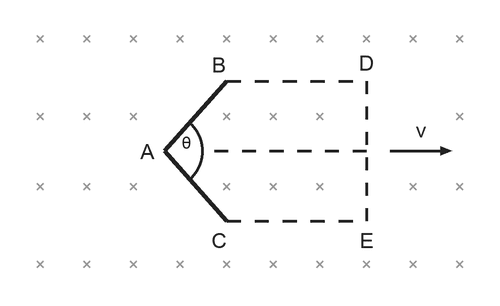
A conductor bent at an angle is kept in a uniform magnetic field as shown in the given figure. Calculate the e.m.f. induced between the ends and of the conductor if it is moved along its bisector. The magnetic field is perpendicular to the plane of the paper.
- 423 marks
Question 42
The given figure shows a long straight wire carrying current placed near another wire frame . The two sides and are connected by another pieces of wire which can slide along the wire frame with a constant velocity towards right. If and its resistance is find the current induced in the loop in terms of the separation between the straight wire and the connector .
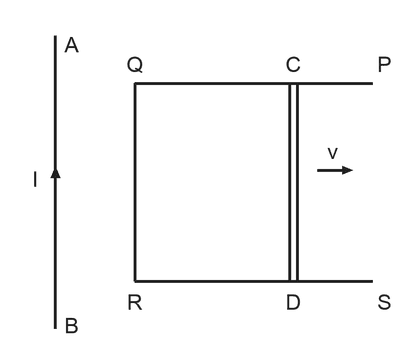
- 434 marks
Question 43
An infinitesimally small bar magnet of dipole moment is pointing and moving with speed in the -direction. A closed circular conducting loop of radius and negligible self-inductance lies in the - plane with its centre at and its axis coinciding with the -axis. Find the force opposing the motion of the magnet, if the resistance of the loop is . Assume that the distance of the magnet from the centre of the loop is much greater than .
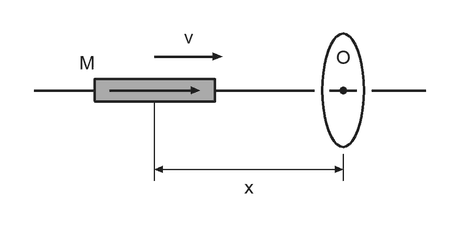
- 444 marks
Question 44
An electromagnetic brake system which works on the principle of eddy current consists of a disc of conductivity and thickness rotating about an axis passing through its centre with a uniform magnetic field applied perpendicular to the plane of the disc over a small area . Find the torque tending to slow down the brake at the instant when its angular velocity is equal to , if the area is at a distance from the axis of rotation.
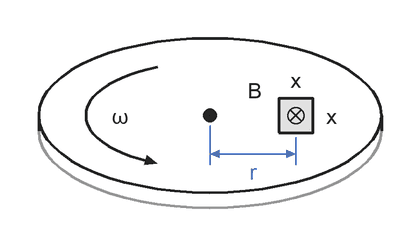
- 454 marks
Question 45
A square metal wire loop of side cm and resistance one ohm is moved with a constant velocity in a uniform magnetic field of induction as shown in the given figure. The magnetic field lines are perpendicular to the plane of the loop directed into the paper. The loop is connected to a network of resistors each of value . The resistance of lead wires and are negligible. What should be the speed of the loop so as to have a steady current of mA in the loop? Also indicate the direction of current in the loop.
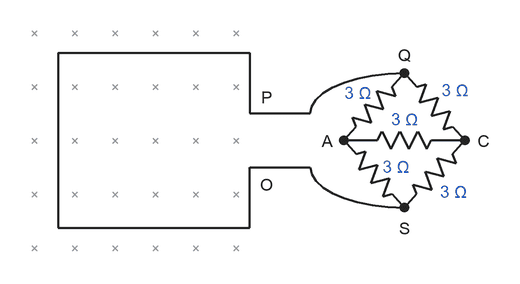
- 463 marks
Question 46
and are two parallel conductors at a distance apart and connected by a resistance as shown in the given figure. They are placed in a magnetic field which is perpendicular to the plane of the conductor. A wire is placed over and and then made to slide over and with a velocity . Neglecting the resistance , and wire , calculate the work done per second to slide the wire .

- 473 marks
Question 47
Define coefficient of mutual inductance of a pair of coils. A solenoidal coil has turns per cm along its length and a cross-sectional area of . turns of another wire is wound round the first solenoid coaxially. The two coils are electrically insulated from each other. Calculate the mutual inductance between the two coils.