Three hoardings of an advertisement were placed by a business house at B, C and D at different heights on a building. A person views them from a point P at a distance of 20 metres from the building and observes the angles of elevation of C and D as double and triple of the angle of elevation of B, respectively. Take the height of hoarding B above the ground as AB=10 m. (This height is supplied here because the printed question omits it; without it part (i) cannot be answered.)
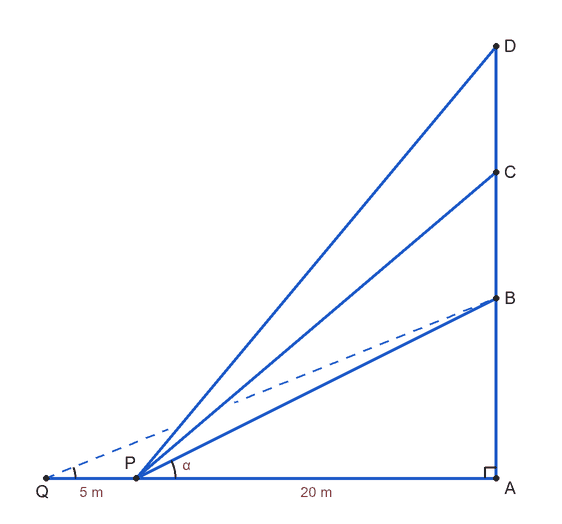
(Figure not to scale.)
Based on the given information, answer the following questions.
(i) Measure of angle α is
(A) tan−1(2) (B) tan−1(21) (C) tan−1(1) (D) tan−1(3)
(ii) Measure of ∠CPA is
(A) tan−1(43) (B) tan−1(3) (C) tan−1(34) (D) tan−1(4)
(iii) Measure of ∠DPA is
(A) tan−1(11) (B) tan−1(3) (C) tan−1(112) (D) tan−1(211)
(iv) If some other viewer observes from a position Q located on the same line across the road, the distance PQ being 5 metres, then ∠BPA−∠BQA= __________.
(A) tan−1(121) (B) tan−1(81) (C) tan−1(52) (D) tan−1(2111)
(v) Domain and range of tan−1x are
(A) R+, (−2π,2π) (B) R−, (−2π,2π) (C) R, (−2π,2π) (D) R, (0,2π)
